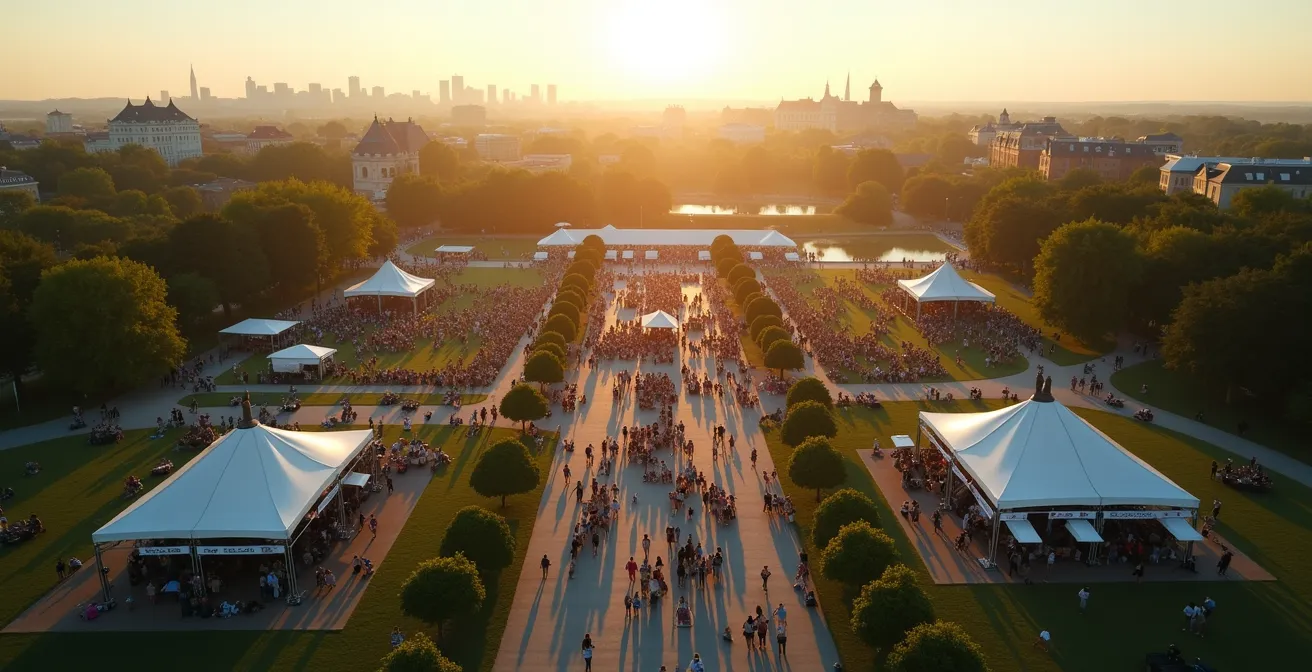
The secret to enjoying Ottawa’s packed festivals isn’t avoiding people, but mastering the operational flow of the event.
- Your choice of neighborhood and transit method has a greater impact on your experience than the day you choose to go.
- Strategic timing—from the week you visit to the minute you arrive at a stage—dictates whether you face a wall of people or a clear path.
Recommendation: Stop being a passive attendee; start thinking like an event planner to reclaim your festival experience.
There’s a fundamental conflict every festival-goer in Ottawa knows: the magnetic pull of a headline act at Bluesfest or the breathtaking beauty of the tulips in May, set against the frustrating reality of human gridlock. You love the energy, but you dread the queues, the packed spaces, and the feeling of being swept along by a tide of people. The common advice is to “go on a weekday” or “arrive early,” but this barely scratches the surface. It’s tactical, not strategic.
From an operational perspective, a festival is a system of flows and pinch points. The real mistake isn’t attending on a Saturday; it’s failing to understand the dynamics of the event. It’s about not seeing the festival ground as a chessboard where a few smart moves can completely change the game. The key isn’t just to avoid crowds, but to outsmart them by leveraging time, space, and insider knowledge. It’s about achieving operational foresight.
But what if you could trade the stress of the crowd for the strategic calm of an operations manager? What if you knew which side of the stage to approach, which transit option is the true local secret during Winterlude, or which neighborhood offers a logistical advantage? This isn’t about finding a secret, empty festival; it’s about mastering the major ones.
This guide provides that strategic framework. We will move from the macro-level decisions like accommodation and timing down to the micro-level tactics for navigation and positioning. You’ll learn to see the patterns, anticipate the movements, and finally experience Ottawa’s world-class events on your own terms, not the crowd’s.
To navigate this strategic approach, this guide breaks down the essential operational elements for mastering Ottawa’s festival scene. The following sections offer insider analysis on everything from accommodation and transit to ticketing and timing.
Summary: A Strategic Guide to Ottawa’s Festival Scene
- Why Hotel Prices Triple During the Tulip Festival?
- How to Get Between the 3 Winterlude Sites via the Sno-Bus?
- Full Festival Pass or Day Ticket: Which Is Worth It for Bluesfest?
- The Weather Mistake That Ruins Your Tulip Festival Photos
- What Time Should You Arrive at the Gate to Get Front Row Spots?
- Downtown Core or The Glebe: Which Base Suits Your Weekend Trip?
- How to Photograph the Parliament Library Without Glare from the River?
- How to Time Your Visit to Catch Ottawa’s peak Cultural Festivals?
Why Hotel Prices Triple During the Tulip Festival?
The first strategic decision you’ll make is your home base, and sticker shock during festival season is a common pain point. The “why” is simple supply and demand. For example, the Canadian Tulip Festival attracts over 1 million visitors into a concentrated area, causing a surge in demand for a fixed number of hotel rooms in the downtown core. This predictable spike gives hotels leverage to dramatically increase prices.
Thinking like an operations manager means bypassing this central pinch point entirely. The amateur visitor focuses only on hotels within walking distance of Parliament Hill or the ByWard Market. The strategist looks at the city’s transit and geography as assets to be leveraged. The goal is to find a location that offers better value without sacrificing accessibility.
Instead of paying a premium for proximity, a smarter approach is to prioritize access via the O-Train or a short bus ride. This opens up vibrant neighborhoods with better pricing and a more authentic local feel. The solution isn’t to just “book early” but to book smarter by redefining what constitutes a “good” location. Consider these alternative accommodation strategies:
- Book accommodations in Gatineau, just across the river, for prices that can be 30-50% lower.
- Check university residences at Carleton University and the University of Ottawa, which often open to the public in May.
- Target neighborhoods like Hintonburg or Westboro, which have direct O-Train access to downtown.
- Book on “shoulder nights,” like the final Sunday of a festival or the Thursday before it officially opens, for significant savings.
- For the truly budget-conscious, use one of Ottawa’s park-and-ride lots and stay in a more affordable suburb, avoiding downtown accommodation costs entirely.
How to Get Between the 3 Winterlude Sites via the Sno-Bus?
The official answer for navigating Winterlude’s dispersed sites—from the ice sculptures in the core to the activities at Dow’s Lake—is the OLG Sno-Bus. While convenient, it’s also a major pinch point, especially on weekend afternoons. Relying solely on the bus is a rookie mistake that can lead to long waits in the cold and crowded rides. The strategic alternative is to leverage one of Ottawa’s most unique assets: the Rideau Canal Skateway itself.
During Winterlude, the canal isn’t just a recreational attraction; it’s a 7.8 km transportation artery. As an official partner of the festival, the Rideau Canal Skateway connects downtown sites directly to Dow’s Lake. Locals have long used it as a functional winter highway, offering a direct and often faster route than the congested Sno-Bus. Skating between venues turns transit time into part of the festival experience. A moderate skater can cover the distance between major sites in 30-45 minutes, a timeframe that can easily be lost just waiting for a bus.

As you can see, the experience of gliding along the canal offers scenic views and a sense of freedom that a crowded bus simply cannot match. Skate rental shops are strategically positioned at major entry points, making this option accessible even for visitors without their own equipment. This is a prime example of asset leverage: using a feature of the city’s landscape to bypass a logistical bottleneck and enhance your overall experience.
Full Festival Pass or Day Ticket: Which Is Worth It for Bluesfest?
The choice between a full festival pass and a single-day ticket for an event like RBC Bluesfest is a classic case of experience triage. It’s not just about cost; it’s about aligning your purchase with your strategic intent. Are you there for one specific headliner, or are you there to immerse yourself in the full breadth of the musical offerings? A day pass is a surgical strike, while a full pass is a campaign.
From an operational standpoint, the value proposition of each ticket type changes based on your goals. The day pass offers precision but limits flexibility. The full pass offers discovery and freedom but requires a larger upfront investment and a commitment of time. To make the right call, you need to analyze the trade-offs beyond the simple price tag. The following table breaks down the key variables for your decision-making process.
| Option | Cost Range | Best For | Hidden Benefits |
|---|---|---|---|
| Day Pass | $80-$120 | Specific headliners only | Can be combined with plans at off-site after-party venues. |
| Full Festival Pass | $300-$400 | Music discovery & attending multiple days | Allows for spontaneous stage-hopping and access to VIP areas on slower days. |
| Volunteer Pass | Free (with ~3 shifts) | Budget-conscious fans who want immersion | Provides a behind-the-scenes experience and networking opportunities. |
The hidden benefits are where the strategic thinking lies. A full pass isn’t just about seeing more bands; it’s about the freedom to leave a crowded stage and discover a lesser-known artist, knowing you can come back another day. It transforms the festival from a series of must-see appointments into a landscape of opportunity. The volunteer pass is the ultimate insider move, trading time for unparalleled access and a deep understanding of the festival’s inner workings.
The Weather Mistake That Ruins Your Tulip Festival Photos
For the Canadian Tulip Festival, the main attraction is visual. While access to the parks like Commissioners Park is generally free, achieving that perfect, vibrant photo is a common goal that is often sabotaged by one key variable: wind. The area around Dow’s Lake is notoriously breezy, and even a moderate wind can turn a field of sharp, elegant tulips into a blurry mess of colour. Most amateur photographers blame their camera or skills, but the real issue is a lack of operational foresight regarding weather and timing.
The strategic photographer knows that the best light often coincides with the calmest conditions. Fighting the wind with a fast shutter speed is a reactive tactic; arriving when the wind is naturally at its lowest is a proactive strategy. This often means visiting during times that are less crowded anyway, creating a win-win scenario for both your photos and your peace of mind. Instead of showing up mid-day with the masses, consider a more calculated approach.
Mastering tulip photography is less about your lens and more about your logistics. By planning your visit around atmospheric conditions and crowd flow, you can capture stunning images without the frustration. Here are some pro-level tips for timing your visit:
- Visit between 7 AM and 8 AM for the calmest conditions before the Dow’s Lake wind typically picks up.
- Check the National Capital Commission’s online Tulip Meter to time your visit for the peak bloom period perfectly.
- If you must shoot in the wind, use a faster shutter speed (at least 1/500s) to freeze the motion of the flowers.
- Explore the tulip beds at Major’s Hill Park, which offer a stunning Parliament backdrop and are often less crowded than Commissioners Park.
- For unique varieties, seek out the test beds at Commissioners Park, where new types of tulips are grown.
By treating your photoshoot like a planned operation rather than a casual stroll, you can sidestep the most common frustrations and walk away with images that truly do justice to the festival’s beauty.
What Time Should You Arrive at the Gate to Get Front Row Spots?
Securing a prime spot at a major concert is the ultimate goal for many festival-goers, but it’s an objective often pursued with more enthusiasm than strategy. The common thinking is that getting to the front is a simple function of arriving ridiculously early. While there’s truth to that, an operations manager sees it as a more complex equation involving positioning, timing, and understanding crowd psychology. It’s not just about being early; it’s about being smart about *where* you are and *when* you move.
First, redefine “front row.” The absolute centre is a high-pressure zone with poor sound quality and a difficult exit path. The strategic position is often slightly to the front-side, near the sound-mixing towers or along a barrier. These spots offer superior audio, a clearer line of sight, and an easier path to washrooms or vendors. This is classic experience triage: sacrificing the bragging rights of “dead centre” for a vastly superior and more sustainable experience.
Second, leverage the flow dynamics of the crowd. The biggest shift in population happens in the 15-20 minutes after an opening act finishes. Many people leave to get food or use the washroom, creating a brief window of opportunity. This “post-set shuffle” is the perfect moment to advance several rows with minimal effort. While others are making a chaotic dash, you can make a calculated move. A blanket or chair (where permitted) can also be used to mark your territory during less-crowded daytime sets, establishing a base of operations for the evening headliner.
Your 5-Point Festival Plan Audit
- Identify Pinch Points: Before you go, list all potential bottlenecks for your target event (e.g., specific security gates, main stage food courts, O-Train transfer stations).
- Gather Intelligence: Collect key data—the official event map, the full performance schedule, the sun’s path for photo ops, and the detailed weather forecast.
- Assess Your Priorities: Cross-reference your “must-see” list with the schedule and map. Is your plan logistically sound, or does it require a frantic dash across the festival grounds?
- Define Experience Goals: Decide what you truly want—the raw energy of the front row, the perfect acoustics near the sound booth, or the relaxed vibe from the back lawn? Be honest about the trade-offs.
- Build Your Strategic Itinerary: Draft a timed action plan that routes you around, not through, the identified pinch points, allowing you to achieve your specific experience goals.
Downtown Core or The Glebe: Which Base Suits Your Weekend Trip?
The choice between staying in the Downtown Core versus a neighborhood like The Glebe is a foundational strategic decision that dictates the entire tone of your festival weekend. It’s a classic trade-off between high-energy, tourist-focused convenience and a more relaxed, authentic local experience. An operational assessment reveals that the “best” neighborhood is entirely dependent on which festival is your priority and what kind of experience you’re seeking.
The Downtown Core, encompassing the ByWard Market and the streets around Parliament, places you in the epicentre of action for events like Winterlude’s ice sculpture displays and Canada Day celebrations. However, this comes at the cost of higher prices and a constant thrum of activity. The Glebe, by contrast, is an upscale residential neighborhood bordering the Rideau Canal. It’s the ideal base for the Tulip Festival, with Dow’s Lake right at its doorstep, and offers a more peaceful, family-friendly vibe. The choice isn’t about which is better, but which is better *for you*.

This view highlights the geographical differences that should inform your strategy. But the analysis shouldn’t stop there. Other neighborhoods like Hintonburg and Westboro, located a short ride away on the O-Train’s Confederation Line, offer a third option: the trendy, foodie-focused experience. They provide excellent transit access to all major festival sites while immersing you in the city’s best local restaurants and shops.
| Neighborhood | Best For Festivals | Price Range | Vibe | Transit Access |
|---|---|---|---|---|
| Downtown Core | Winterlude, Canada Day | $$$ | High energy, tourist-focused | Multiple transit lines |
| The Glebe | Tulip Festival (Dow’s Lake) | $$ | Family-friendly, upscale-local | Canal pathways, buses |
| Hintonburg | All festivals | $$ | Trendy, foodie-focused | O-Train direct access |
| Westboro | All festivals | $$ | Local, authentic | O-Train, bike paths |
How to Photograph the Parliament Library Without Glare from the River?
Even outside of official festival grounds, applying strategic thinking can solve common visitor problems. A prime example is photographing the iconic Library of Parliament. Many tourists attempt the shot from the Ottawa side of the river, only to be frustrated by harsh glare reflecting off the water, especially in the afternoon. This is a problem of positioning and timing, not equipment.
The insider’s solution, as many local photographers know, is to change your vantage point entirely. By crossing the river to Gatineau, you position the sun behind you for much of the day, eliminating the glare and illuminating the intricate details of the Gothic Revival architecture. The grounds of the Canadian Museum of History or the Sentier des Voyageurs pathway provide a perfect, unobstructed platform for this superior angle. The information is readily available for those willing to look, with official sources like Destination Canada often highlighting the city’s photogenic qualities.
This principle of “changing the angle” applies in all seasons. In winter, the frozen Rideau Canal offers a unique low-angle perspective that is impossible to get at any other time of year. The key is to stop fighting the conditions and instead use geography and time of day to your advantage. Here are several strategic angles to consider:
- Canadian Museum of History Grounds (Gatineau): The classic, glare-free shot.
- Early Morning on the Ottawa Side: Shoot when the sun is behind you, rising in the east.
- Sentier des Voyageurs Pathway (Gatineau): Offers a slightly different, elevated perspective from the Quebec side.
- Frozen Rideau Canal (Winter): Provides a dramatic, low-angle view directly from the ice.
- Corktown Footbridge: This pedestrian bridge offers a compressed perspective, using the river’s reflection as a compositional element rather than a source of glare.
- Use a Circular Polarizing Filter: If you must shoot from the Ottawa side in bright light, this piece of equipment is the only technical solution to minimize water glare.
By applying a bit of logistical planning, you can solve a common photographic problem and capture a truly professional-quality image of one of Canada’s most famous landmarks.
Key Takeaways
- Festival success hinges on strategic planning, not just reacting to crowds.
- Leveraging city infrastructure like the O-Train and Rideau Canal Skateway provides a significant logistical advantage.
- Your choice of accommodation and timing has a greater impact on your experience than your choice of which day to attend.
How to Time Your Visit to Catch Ottawa’s peak Cultural Festivals?
All the micro-strategies for navigating crowds are valuable, but the ultimate strategic decision is made at the macro level: when to visit. Ottawa’s festival season is a dense calendar of events, and understanding its rhythm is key to maximizing your experience. The city’s reputation as a festival hub is well-earned; Ottawa’s festival season attracts over 3 million attendees annually, creating a vibrant but often overwhelming atmosphere.
The strategic visitor looks for the “sweet spots” in the calendar—moments where major events overlap or where you can catch the peak of an event just before or after the largest crowds descend. This requires looking beyond the official start and end dates and understanding the internal rhythm of each festival. For example, the second weekend of the Tulip Festival often showcases the most spectacular blooms while avoiding the opening weekend rush.
Similarly, planning a trip around the July 1st period allows you to experience the massive Canada Day celebrations and then seamlessly transition into the opening days of Bluesfest, which are often less crowded than the final weekend. By thinking in terms of “stacking” events and targeting shoulder periods, you can craft a visit that is far more efficient and enjoyable. Here are some of the key strategic timings to consider for your Ottawa festival calendar:
- Late May: Stack the Canadian Tulip Festival with the Ottawa Children’s Festival for a diverse cultural experience.
- Second Weekend of Tulip Festival: Often the best time for peak blooms without the initial opening rush.
- July 1st Period: Blend Canada Day on Parliament Hill with the opening days of RBC Bluesfest.
- Weekdays during Bluesfest: Experience the festival with a more relaxed atmosphere and easier access to stages and vendors.
- June: The Ottawa Jazz Festival offers a world-class lineup with smaller crowds than the summer peak of Bluesfest.
- September: Experience a more local vibe with CityFolk Festival and the traditional Richmond Fair.
- February Weekdays during Winterlude: Enjoy all the main attractions, including the Skateway and ice sculptures, without the intense weekend crowds.
Ultimately, mastering Ottawa’s festivals is about shifting your mindset. It’s about seeing the city and its events not as an obstacle course, but as a system you can understand and navigate with intelligence and foresight.
By adopting this operational mindset, you transform from a passive attendee into an active strategist, ensuring every festival visit is defined by enjoyment, not frustration. The next step is to take these principles and apply them to your own festival plan.