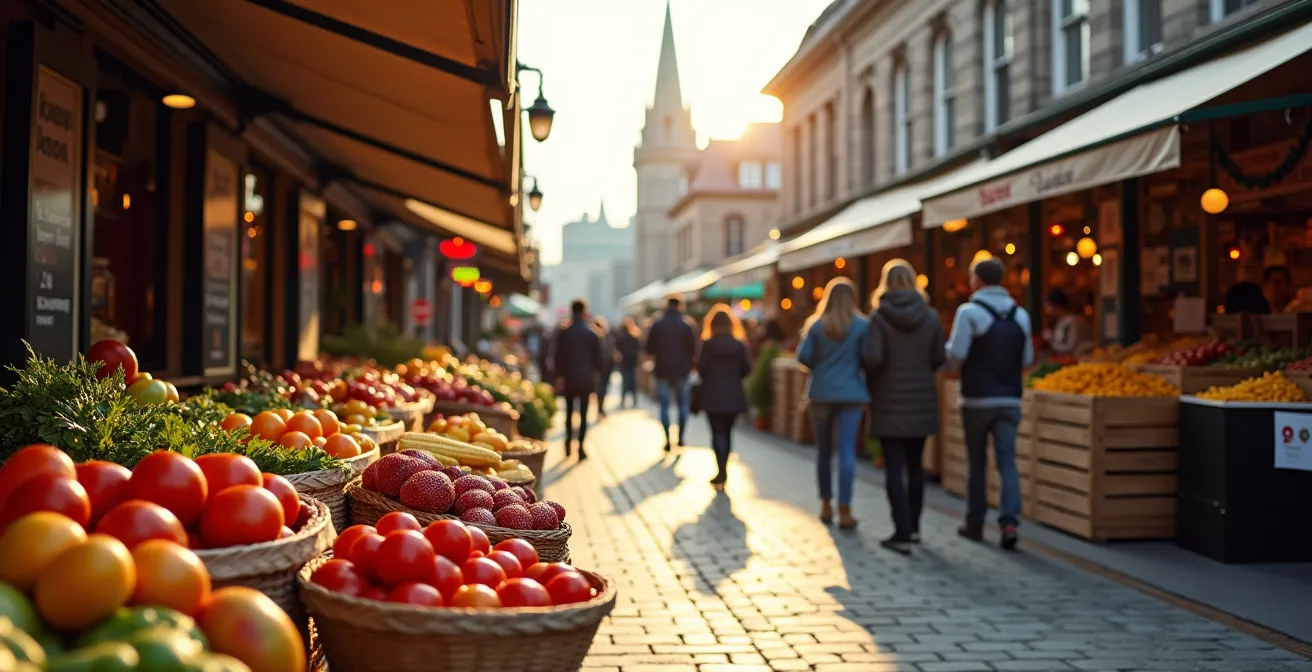
In summary:
- Navigate the market strategically by understanding its history and layout, not just following the crowds.
- Identify authentic vendors, like the original Obama Cookie bakery, by looking for specific historical markers.
- Save time and money by knowing when to choose street food and when a patio offers better value.
- Master the local etiquette, from the “Bonjour, hi!” greeting to the correct tasting order for cheese and pastries.
- For the best dining, follow local chefs to the restaurants in Wellington West, just outside the market.
The ByWard Market can feel like a delicious labyrinth. The air is thick with the smell of sizzling sausages and sweet pastries, and every corner promises a new culinary discovery. But for every authentic, family-run food stall, there’s an overpriced, generic equivalent waiting for an unsuspecting tourist. Many visitors leave having tried a BeaverTail and maybe a poutine, feeling they’ve “done” the market but missing its true heart. They follow the biggest lines, eat at the most visible patios, and walk away with a full stomach but an inauthentic experience.
The common advice is to “explore” or “talk to vendors,” but this is vague. Without a strategy, exploring means wandering into the same crowded zones as everyone else. And what do you say to a vendor on a busy Saturday morning? The secret to conquering the market isn’t about having a list of “top spots”; it’s about understanding the market’s rhythm, its history, and its unwritten rules. It’s about knowing how to navigate it with purpose.
But what if you could trade the long queues and tourist clichés for genuine flavours and insider knowledge? What if the key wasn’t just *what* to eat, but *how*, *when*, and *why*? This guide is your playbook for a strategic food tour. We’ll decode the market’s history, reveal the simple mistake that costs visitors 30 minutes in line, and teach you the professional tasting order for a perfect food crawl. You’ll learn the difference between a tourist meal and a local’s feast, turning your visit from a simple walk-through into a memorable gastronomic adventure.
This article provides a complete roadmap for your culinary exploration. Each section builds on the last, giving you the tools to experience the ByWard Market—and beyond—with the confidence of a local food expert. Below is a summary of the strategic insights you are about to uncover.
Summary: How to Master the ByWard Market Food Scene
- Why Is the ByWard Market Building Actually a Heritage Landmark?
- How to Find the Original Obama Cookie Bakery Amongst the Copies?
- Street Stand vs Sit-Down Patio: Which Offers Better Value in the Market?
- The Saturday Morning Mistake That Costs You 30 Minutes in Line
- In What Order Should You Sample Cheese, Bread, and Pastries?
- How to Greet Shopkeepers in ByWard Market Without Feeling Awkward?
- Ottawa Pubs vs Gatineau Bars: Which Side Has Better Energy?
- How to Find the Best Restaurants in Wellington West?
Why Is the ByWard Market Building Actually a Heritage Landmark?
Before you take a single bite, understanding where you are elevates the entire experience. The main ByWard Market building isn’t just a food court; it’s the heart of one of Canada’s oldest and largest public markets. Its status as a heritage landmark isn’t just about its age; it’s about how the very design of the building and the surrounding streets tells the story of Ottawa’s food culture. The structure you see today is a living museum, purpose-built for the vendors and farmers who have been its lifeblood for nearly two centuries. Recognizing this history is the first step in separating the authentic from the purely commercial.
The market’s layout, established in the 1860s, was designed for a seamless flow of goods and people, a principle that still defines its chaotic energy today. The architecture itself is a guide. According to the Government of Canada’s directory of historic places, many of the surrounding structures are some of the earliest surviving commercial buildings in Ottawa. The Tudor Gothic architectural style and the large ground-floor openings weren’t just decorative; they were functional elements for 19th-century vendors. When you spot these features, you’re not just looking at an old building; you’re seeing the framework that has supported local Ottawa food artisans for generations. This context helps you appreciate the vendors who are part of this long-standing tradition.
As you walk, look for these signs of history. Notice the mid-nineteenth-century gable-fronted buildings or the mix of vernacular styles that show how the market has continuously evolved without losing its core identity. This isn’t just an architectural tour; it’s a way to train your eye. The vendors located in or near these historically significant spots are often the ones with the deepest roots in the market. Understanding this history gives you an anchor, a way to start your culinary navigation with meaning, well before you even think about what to eat first.
This historical lens transforms you from a passive consumer into an active observer, ready to engage with the market on a deeper level.
How to Find the Original Obama Cookie Bakery Amongst the Copies?
One of the market’s most famous stories is that of the “Obama Cookie.” In 2009, during his first official visit to Canada, President Barack Obama made an unscheduled stop that would change a local bakery forever. This one moment created a culinary legend, but it also spawned a host of imitators. Knowing how to find the *original* spot, Le Moulin de Provence, is a classic test for any discerning food tourist. It’s not just about the cookie; it’s about participating in an authentic piece of Ottawa history.
The story itself is part of the flavour. As recounted in a detailed article by Maclean’s magazine, the presidential motorcade pulled up unexpectedly, and Obama himself walked in to buy a maple leaf-shaped shortbread cookie, exclaiming, “I love this country.” This genuine, spontaneous moment is what separates the original from the rest. Many other shops might claim “Obama visited the Market,” which is true, but he only entered one bakery. Finding it is your first mission.

So, how do you spot the real deal? Don’t just look for any red-and-white maple leaf cookie. The authentic Le Moulin de Provence is located at 55 ByWard Market Square, at the York Street entrance of the main market building. The key identifiers are the photos of Obama prominently displayed in the windows and on the doors, often showing him with former Governor General Michaëlle Jean. Look for the sign that explicitly says, “Obama cookies sold here.” The bakery leans into its history, so if the connection feels subtle or absent, you’re likely in the wrong place. This is a clear case where a little bit of historical knowledge helps you cut through the noise and find the genuine article.
Getting your cookie from the original source isn’t just a photo opportunity; it’s your first successful act of avoiding a tourist trap and tasting a real piece of Ottawa lore.
Street Stand vs Sit-Down Patio: Which Offers Better Value in the Market?
One of the biggest decisions you’ll make in the ByWard Market is where to spend your money and time: at a quick-service street stand or a full-service sit-down patio? The answer isn’t about which is “better” overall, but which offers superior value for your specific goal. A tourist might see a patio as a comfortable, premium experience, while a local knows that the best flavours often come from a humble window. Understanding the “value equation”—balancing cost, time, authenticity, and experience—is key to a smart dining strategy.
Street stands are the lifeblood of the market. They offer speed and authenticity, with items typically priced between $5 and $15. You’ll get your food in under 10 minutes, making it ideal for a fast-paced tasting tour. These vendors are often family-run, serving recipes passed down through generations. However, you’re at the mercy of the weather, with little to no shelter. Patios, on the other hand, provide comfort and a relaxed atmosphere, with heated options making them viable year-round. But this comfort comes at a price: meals range from $15 to $35, and you can expect to wait anywhere from 20 to 45 minutes for your food and service.
The following table, based on data from the official ByWard Market website, breaks down the core differences to help you decide.
| Factor | Street Stands | Sit-Down Patios |
|---|---|---|
| Price Range | $5-15 per item | $15-35 per meal |
| Wait Time | 5-10 minutes | 20-45 minutes |
| Best Season | May-October (peak summer) | Year-round (heated patios) |
| Experience | Quick, authentic, people-watching while walking | Relaxed, comfortable seating, table service |
| Local Authenticity | High – vendors often family-run | Mixed – varies by establishment |
| Weather Dependency | Very high – no shelter | Low – covered/heated options |
A savvy local doesn’t choose one over the other; they mix and match. The ultimate strategy is to grab your main dish from an iconic, high-value street stand like BeaverTails or a sausage vendor. Then, take that food to a nearby brewery or bar patio that allows outside food. This hybrid approach gives you the authentic, affordable flavour of a street stand with the comfort and ambiance of a patio, letting you enjoy a craft beer with your meal. It’s the best of both worlds and a hallmark of an experienced market-goer.
By thinking strategically about where you eat, you optimize your budget, your time, and the authenticity of your experience.
The Saturday Morning Mistake That Costs You 30 Minutes in Line
The single biggest mistake visitors make is arriving at the ByWard Market between 10:30 AM and 12:00 PM on a Saturday. It seems like the logical time to go, but it’s precisely when the tourist rush collides with locals finishing their shopping, creating peak congestion. The market can see an average of 50,000 visitors per weekend during high season, and a significant portion of them are funneled through the main entrances from Sussex Drive and Rideau Street during this two-hour window. This timing mistake can easily cost you 30 minutes in line for popular items, turning a fun food tour into a frustrating waiting game.
Avoiding this trap doesn’t mean skipping the market on a Saturday; it means outsmarting the crowds with a local’s detour strategy. Locals know that the flow of people is predictable and can be bypassed. Instead of using the main entrances, start your journey from the quieter sides of the market, like St. Patrick Street or Murray Street. These entry points are less crowded and put you in immediate proximity to fantastic vendors without the bottleneck.

The other part of the strategy is timing. Arrive between 8:00 AM and 9:00 AM. This is when Ottawans are there to buy fresh produce and bread for the week. The atmosphere is more local, the lines are short, and the vendors are fresh and happy to chat. Alternatively, visit during the “golden hour” of 2:00 PM to 4:00 PM, after the lunch rush has subsided but before vendors start packing up. You get the full selection with a fraction of the crowd. This strategic timing and routing is the essence of navigating the market like an insider.
Your Action Plan: The Local’s Crowd Detour Strategy
- Enter the market from the St. Patrick Street or Murray Street side, not the main Sussex Drive entrance.
- Arrive between 8-9 AM to experience the market with locals, or between 2-4 PM to miss the peak tourist rush.
- Use the BeaverTails stand on the market’s outskirts (e.g., near George Street) instead of the main central one to cut your wait time.
- For popular delis like La Bottega Nicastro, call ahead for pickup orders to skip the notoriously long sandwich line entirely.
- Start your morning at less-crowded coffee shops on the periphery (like on Dalhousie Street) before heading to the central market attractions.
By simply adjusting your entry point and your timing, you can transform a stressful, crowded experience into a pleasant and efficient culinary exploration.
In What Order Should You Sample Cheese, Bread, and Pastries?
Once you’ve navigated the crowds and chosen your vendors, the next strategic challenge is the order of consumption. A food tourist might grab the first thing that looks good—often a sugary BeaverTail or a rich pastry. This is a rookie mistake that can sabotage your entire tasting tour. A blast of sugar or a powerful, pungent cheese will overwhelm your taste buds, making it impossible to appreciate the subtle, delicate flavours of other foods. A local, on the other hand, follows an unspoken rule: the Palate Preservation Strategy. This is a methodical approach to tasting that ensures each item is enjoyed to its fullest potential.
The principle is simple: start with neutral or mild flavours and progress to the boldest and sweetest. Your first stop should always be for crusty, artisanal bread. Bread acts as a neutral base and a palate cleanser throughout your tour. From there, move on to hard, mild cheeses. Think of a local St-Albert cheddar or a simple gouda. These cheeses are flavourful without being overpowering. Only after you’ve sampled the milder varieties should you progress to the soft, pungent cheeses, like a bold Quebec blue cheese or a creamy, washed-rind variety. Their powerful flavours would have completely masked the taste of the hard cheddars if you had eaten them first.
Sweet items must always, without exception, come last. A sugary pastry or, most importantly, a BeaverTail, should be the grand finale of your tour. The intense sweetness coats your palate and effectively ends your ability to taste nuanced flavours. As one local food tour guide advises, the key to a successful self-guided tour is pacing and planning.
It took us about three hours to complete the entire map… I also recommend bringing a bag to carry your goodies in as you’ll receive a few things to take home with you. We also chose to box some of our food for later to make sure we could eat at all the stops.
– Little Miss Ottawa, ByWard Bites: An Amazing Self-Guided Food Tour
This advice to box up food for later is brilliant. Don’t feel pressured to eat everything at once. Buy your bread, cheese, and pastries, and assemble the perfect picnic to enjoy in a nearby park, savouring each component in the correct, palate-preserving order.
By following this simple sequence, you transform your eating from a random series of snacks into a structured, professional-level tasting experience.
How to Greet Shopkeepers in ByWard Market Without Feeling Awkward?
Interacting with vendors is a huge part of the market experience, but it can also be a source of anxiety. Do you speak English or French? Is it okay to ask for a sample? Is haggling acceptable? Knowing the local etiquette—what we’ll call the “Bonjour, hi!” Protocol—can make the difference between a transactional purchase and a memorable human connection. In a city as officially bilingual as Ottawa, the way you start a conversation matters.
The golden rule is to lead with “Bonjour, hi!” This uniquely Ottawa greeting is a sign of respect. It immediately tells the shopkeeper that you acknowledge both languages and invites them to respond in whichever they are more comfortable with. It’s a small gesture that goes a long way. After this initial greeting, your approach should vary. For a farm stand, a simple “Hello” followed by a direct question about the produce (“Are these local strawberries?”) is perfectly fine. For more artisanal shops selling cheese or cured meats, show genuine interest. A phrase like, “I’ve heard great things about your products, what are you most proud of today?” opens the door for a real conversation.
Just as important is knowing what *not* to do. The quickest way to signal you’re just a transaction is to lead with “How much is this?” Also, you must never haggle over prices. It is not part of the culture at ByWard Market food shops, and attempting to do so is considered disrespectful. Finally, be mindful of your physical space. If you are browsing on your phone or deciding what to buy, step to the side so other customers can be served. Shopkeepers appreciate quick, decisive interactions on a busy Saturday morning, but they are often much more open to a longer chat about their products’ history on a quiet Tuesday afternoon. Adjusting your conversational style to the time and day shows social awareness and respect.
By using this simple protocol, you move beyond being a mere customer and become a welcome guest in the vendor’s space.
Key Takeaways
- Mastering the ByWard Market is about strategy—knowing when to go, where to enter, and in what order to taste.
- Authenticity often lies in the details: identifying the original Obama Cookie bakery or using the “Bonjour, hi!” greeting.
- For the best value, combine affordable street food with the comfort of a brewery patio that allows outside food.
Ottawa Pubs vs Gatineau Bars: Which Side Has Better Energy?
As day turns to night, your culinary tour may evolve into a pub crawl. Here, you face a classic Ottawa-area dilemma: stay in the ByWard Market’s English-style pubs, or cross the bridge to Gatineau for a taste of Quebec’s nightlife? Neither is definitively “better,” but they offer vastly different energies, and knowing the difference is crucial for finding the vibe you’re looking for. Ottawa’s side is defined by its classic rock pubs and sports bars, while Gatineau brings a high-energy, francophone, late-night dance scene.
The primary difference comes down to timing and crowd. Ottawa pubs, centered in the market, cater to an after-work professional crowd and tourists. The energy peaks between 7 PM and midnight, with a firm last call at 2:00 AM. It’s a conversational, English-speaking environment perfect for a relaxed pint. Gatineau, just a five-minute Uber ride away, operates on a different schedule. The bars there, largely populated by students and a younger crowd, don’t truly get going until 11 PM and stay open until last call at 3:00 AM. The atmosphere is dominated by electronic music, a vibrant dance floor, and a primarily French-speaking vibe.
This comparative table highlights the key distinctions to help you plan your night:
| Factor | Ottawa (ByWard Market) | Gatineau |
|---|---|---|
| Last Call | 2:00 AM | 3:00 AM |
| Crowd Type | Tourists & after-work professionals | Students & younger crowd |
| Music Style | Classic rock, sports bar atmosphere | Electronic, dance, francophone vibe |
| Peak Hours | 7 PM – 12 AM | 11 PM – 3 AM |
| Language | Primarily English | Primarily French |
| Distance from ByWard | You’re already there | 5-minute Uber ride |
The savviest locals don’t choose; they do both. The “Cross-Border Bar Crawl” is a well-known strategy. Start your evening with dinner and early drinks in an Ottawa pub around 8 PM. Enjoy the classic pub atmosphere until about midnight. As the Ottawa bars start to wind down, take a quick ride over to Gatineau to catch the late-night energy and dance until 3 AM. It’s a perfect way to experience the full spectrum of the region’s nightlife in a single evening.
Choosing between Ottawa and Gatineau isn’t about which is superior, but about matching the city’s rhythm to your own desired experience.
How to Find the Best Restaurants in Wellington West?
You’ve mastered the market, navigated the crowds, and even crossed the river for a late-night drink. Now for the ultimate insider tip: for Ottawa’s best sit-down dining, you need to leave the ByWard Market entirely. While the market excels at street food, produce, and lively pubs, the city’s most innovative and acclaimed restaurants are concentrated in another neighbourhood: Wellington West. This area, encompassing Hintonburg and Wellington Village, is known as the place where Ottawa’s chefs eat on their day off. Going here is the final step in transitioning from a tourist to a true food insider.
Unlike the market’s tourist-friendly accessibility, Wellington West is a destination for serious, chef-driven dining. The restaurants here focus on seasonal, innovative menus, and walking in without a reservation is rarely an option for the top spots. This is a fundamental difference in dining culture. The neighbourhood is clustered into distinct culinary zones: Hintonburg is home to high-end tasting menus and craft breweries, while Wellington Village offers cozier, established bistros that have been neighbourhood mainstays for years. Establishments like Supply and Demand or Absinthe require booking weeks in advance, a testament to their quality and local following.
Case Study: The Wellington West Ethos
The reputation of Wellington West is built on its chef-driven approach. Unlike many market restaurants that cater to a transient tourist crowd with stable menus, Wellington West’s top spots feature innovative dishes that change with the seasons, reflecting what’s available from local producers—some of whom sell their wares at the Parkdale Market right in the neighborhood. This focus on culinary artistry over high-volume turnover has made it the go-to destination for Ottawa’s discerning diners, including chefs from other restaurants. The need for reservations isn’t a bug; it’s a feature, ensuring a high-quality, unhurried dining experience that stands in stark contrast to the market’s delightful chaos.
Your visit here should be planned. Start by exploring the Parkdale Market to see the fresh ingredients that inspire the local menus. Grab a famous bagel from the Ottawa Bagelshop and Deli in the morning (they sell out fast). Then, for dinner, choose a restaurant and be sure to book ahead. A meal in Wellington West is the perfect culmination of your Ottawa food journey, showing you’ve learned not only how to conquer the market but also when to venture beyond it for a truly exceptional experience.
To put these strategies into practice, your next step is to book a table at one of these acclaimed restaurants and experience Ottawa’s culinary peak for yourself.