
The feeling of being trapped in Ottawa’s “government town” routine isn’t about your job; it’s about a mindset fixed by your daily geography. The key to breaking free is to consciously architect a new map of “third places”—social environments outside of home and work.
- Your post-work autopilot, from commute to couch, reinforces your professional identity and drains your personal energy.
- Breaking this cycle requires a deliberate “geographic shift” towards spaces that foster new connections and perspectives.
Recommendation: Start tonight by choosing one new “third place”—a café, a climbing gym, a community hub—and make it a non-negotiable stop on your way home.
The clock strikes five, and a familiar silence falls over downtown Ottawa. The uniform river of public servants flows from office towers towards the transitway, a daily migration back to the quiet suburbs. You’re part of that current, but you feel a nagging sense of being stuck. It’s the “government town” mindset—a feeling that your identity is welded to your job title, and that the city itself powers down when the bureaucracy does. You’ve been told the solution is to find a hobby, explore museums, or simply “leave work at work,” but these platitudes miss the point. The problem isn’t a lack of activities; it’s the invisible walls of a routine that keeps you in the same mental and social bubble, 24/7.
This feeling is a paradox in a city that, on paper, has it all. But what if the key to escaping this gilded cage isn’t about adding more to your schedule, but about fundamentally changing your geography? The real solution lies in a concept from urban sociology: the “third place.” These are the environments outside of home (your first place) and work (your second place) where community life unfolds, conversations happen, and new identities are forged. They are the local pubs, the indie coffee shops, the climbing gyms, the bustling markets—the spaces where you’re not just a “Senior Analyst” or a “Director,” but simply a person among people.
This guide is your blueprint for a great escape. It’s not about quitting your job or moving away. It’s about a strategic reclamation of your life after 5 PM. We’ll explore why it’s so hard to break free, how to build a new identity through side projects and community, and most importantly, where to find the “third places” that will serve as the headquarters for your new life. This is about more than work-life balance; it’s about identity architecture, and it starts with your first step out of the office and into a different part of the city.
To help you navigate this transition, this article breaks down the essential strategies for reclaiming your post-work identity. The following sections provide a clear roadmap, from understanding the psychological traps of a government town to discovering the physical spaces that foster genuine connection and purpose.
Summary: Beyond the Hill: Escaping Ottawa’s ‘Government Town’ Mindset
- Why Is It So Hard to Leave a Government Job for a Startup?
- How to Start a Side Hustle in Ottawa’s Gig Economy?
- Cottage Country vs Staycation: Which Actually Recharges You More?
- The Volunteering Mistake That Adds Stress Instead of Purpose
- In What Order Should You Transition from Work to Home Mode?
- Why Ottawa’s Indie Scene Is Exploding While You Sleep?
- How to Find a Quiet Coworking Spot in the Business District?
- Where to Find the Best “Third Places” for Meeting Locals in Ottawa?
Why Is It So Hard to Leave a Government Job for a Startup?
The allure of the startup world—dynamic, innovative, and driven by passion—seems like the perfect antidote to the perceived stability and rigidity of a government career. Yet, for many in Ottawa, making that leap feels like jumping a chasm. The difficulty isn’t just about giving up a pension or a predictable schedule; it’s a deep-seated psychological and cultural barrier. A government job offers more than a salary; it provides a defined identity, a clear ladder of progression, and a community of peers who speak the same language of acronyms and policy briefs. This is the “golden handcuffs” phenomenon, where the comfort and security of the known become a powerful deterrent to the uncertainty of the new.
Leaving this ecosystem means shedding a part of your identity. You’re no longer defined by your department or level, but by your skills, your hustle, and your ability to create value from scratch. This transition can be intimidating, as it forces a confrontation with questions of self-worth outside a structured hierarchy. Furthermore, the risk-averse culture often ingrained in public service is the polar opposite of the “fail fast, learn faster” ethos of the startup scene. The very mindset that ensures stability in government can feel like a liability in an environment that thrives on rapid experimentation.
However, the path from public service to private innovation is more worn than you might think. Many successful entrepreneurs began their careers in government, leveraging their understanding of process, policy, and large-scale systems to their advantage. The key is recognizing that your skills are transferable, not institutional. The ability to navigate complex stakeholder relationships, manage large projects, and communicate clearly are invaluable assets in any startup. Places like the Bayview Yards Innovation Centre, a hub for local tech talent, exemplify this bridge. It’s a space where the structure of government funding meets the dynamism of entrepreneurship, proving that the two worlds aren’t as far apart as they seem and that a transition is a viable path for identity architecture.
Ultimately, the first step isn’t updating your resume, but shifting your perspective. It’s about seeing your experience not as a government-specific liability, but as a unique strategic advantage in a different arena. The leap becomes less about what you’re leaving behind and more about what you’re bringing with you.
How to Start a Side Hustle in Ottawa’s Gig Economy?
A side hustle is more than just extra income; it’s a powerful tool for identity architecture. It’s a low-risk way to explore new passions, develop new skills, and build a professional identity that is entirely your own, separate from your 9-to-5. In a city like Ottawa, where your day job can feel all-encompassing, a side hustle is an act of rebellion—a declaration that you are more than your government title. And you’re not alone; a recent study shows that around 30% of Canadian workers had a side hustle in 2024, indicating a massive shift towards portfolio careers.
The key to a successful side hustle in Ottawa is to leverage the city’s unique ecosystem. Don’t try to compete in a saturated global market; instead, look for the gaps and needs within the local community, especially those related to the dominant government sector. Your “insider” knowledge is your greatest asset. For example, your bilingualism, honed by years in public service, is a highly sought-after skill. You can offer French conversation practice for civil servants preparing for language exams, a niche service with high demand and excellent pay.
Think about the skills you use every day: organization, data management, grant writing, and community facilitation. These can be monetized. You could work as a part-time election officer, offer grant-writing assistance to local arts organizations navigating government funding, or facilitate community programs at public centres. The goal is to find a project that not only brings in revenue but also connects you with a different facet of the city—a “third place” in the gig economy. This creates a positive feedback loop: your side hustle gets you out of your bubble, introduces you to new people, and builds a sense of purpose that energizes you, rather than drains you after a long day at the office.
The first step is to take inventory of your skills, not as they appear on your government performance review, but as valuable services you can offer to others. Start small, test your idea, and let your new identity begin to take shape, one gig at a time.
Cottage Country vs Staycation: Which Actually Recharges You More?
The traditional Ottawa escape involves a grueling Friday afternoon drive up the 417, battling traffic to reach a slice of tranquility in cottage country. The promise is complete disconnection and recharge. But often, the stress of packing, driving, and weekend chores means you return on Sunday night more exhausted than when you left. This raises a crucial question: is the geographic escape the most effective way to achieve a mental decompression? Ironically, in a city ranked first in Canada for work-life balance, the pressure to “escape” can itself become a source of stress. What if the most profound recharge comes not from leaving the city, but from rediscovering it?
A “staycation” is often seen as a consolation prize—a budget-friendly alternative to a “real” vacation. This perspective is flawed. A well-architected staycation can be far more restorative than a frantic weekend getaway because it focuses on changing your *routine* and *mindset* within your existing environment. The goal isn’t just to stay home, but to consciously engage with the city as a tourist of your own life. This means actively seeking out the “third places” you normally bypass in your daily commute. It’s about swapping the highway traffic for a leisurely bike ride along the canal, trading the grocery run for a slow morning at a farmers’ market in a neighbourhood you rarely visit, and discovering the hidden gems that make Ottawa a vibrant place outside of its government core.
The power of a staycation lies in its ability to rewire your relationship with your city. It transforms familiar streets into avenues of discovery. This is your chance to finally visit that indie bookstore in the Glebe, try the food trucks in Centretown, or simply sit on a bench by the Rideau Canal with no agenda.

As you can see, true relaxation is a state of mind, not a location. By intentionally creating moments of peace and discovery within your own city, you build a sustainable practice of recharging. You learn that escape isn’t something you have to drive hours for; it’s a choice you can make any day of the week. This approach doesn’t just give you a restful weekend; it gives you back your city and empowers you to find pockets of joy and calm whenever you need them, breaking the cycle of waiting for the next big escape.
The ultimate measure of a successful break isn’t how far you traveled, but how far you feel from the person who left the office on Friday. Sometimes, the shortest distance can lead to the greatest transformation.
The Volunteering Mistake That Adds Stress Instead of Purpose
Volunteering seems like a perfect solution for the “government town” blues. It offers a sense of purpose, a way to connect with the community, and an activity completely unrelated to work. Many professionals, driven by a desire to give back, jump into demanding roles at non-profits or community boards, hoping to find fulfillment. However, they often make a critical mistake: they treat their volunteer role like a second job. They take on high-stakes responsibilities, commit to rigid schedules, and apply the same high-pressure, results-driven mindset from their office to their volunteer work. Instead of becoming a source of joy and connection, it becomes another source of stress, deadlines, and performance anxiety—a purpose-driven burnout.
The mistake is choosing a volunteer role that mirrors the structure and pressures of the very environment you’re trying to escape. If your day job involves managing complex projects and attending endless meetings, taking on a board position with similar duties won’t provide a mental break; it will simply extend your workday into the evening. The goal of volunteering, in the context of escaping a professional mindset, should be to engage a different part of your brain and spirit. It should be about human connection, physical activity, or creative expression—not about adding more strategic planning to your plate.
The solution is to choose volunteer opportunities based on the *experience*, not just the *mission*. Look for roles that are hands-on, social, and low-pressure. Instead of joining a board, consider helping to maintain a community garden, walking dogs at a local shelter, or being an usher at a music festival. These activities force you out of your head and into the present moment. They provide a sense of tangible accomplishment and, most importantly, create a space for genuine, unstructured social interaction. As one expert on hustle culture noted, finding environments where you can “talk about the craziness of things and make light of them” is incredibly helpful on stressful projects. This same principle applies to finding purpose outside of work; the connection is as important as the contribution.
Before you commit to a cause, ask yourself: “Will this activity recharge me or drain me? Does it feel like a passion or another obligation?” The right volunteer role should be a “third place” for your spirit—a space that gives you more energy than it takes.
In What Order Should You Transition from Work to Home Mode?
The transition from work to home is the most critical and overlooked part of your day. For most people in Ottawa, it’s an autopilot sequence: pack up, commute while listening to news radio, walk in the door, and immediately get absorbed by household chores or slump onto the couch, still mentally processing the day’s work. This seamless slide from “work mode” to “home responsibilities” with no buffer in between is precisely why the government town mindset follows you home. You never give your brain a clear signal that the workday is truly over. To reclaim your evenings, you need to architect a deliberate, multi-step shutdown routine that creates a firm boundary between your professional and personal selves.
This isn’t about simply “not thinking about work.” It’s about creating a series of sensory and physical shifts that force a mental reset. The order of operations matters. The process should start *before* you even leave the office. It begins with a firm mental commitment, followed by a series of actions designed to systematically disengage you from your work identity. This involves changing your environment, your sensory inputs, and your physical state. As researchers from BYU Marriott School suggest, having “something to look forward to after work” makes it easier to shift into ‘nonwork’ mode. This routine is how you build that anticipation directly into your day.
The most effective transition routines are not passive; they are an active and ordered process of mental decompression. It’s a sequence that takes you from a state of high alert and cognitive load to one of relaxation and personal presence. By creating a deliberate buffer zone between your second place (work) and your first place (home), you carve out essential space for your “third place” self to emerge. This might be a literal stop at a café or park, or it could be a series of actions you take during your commute and upon arrival home. The key is consistency and intentionality.
Your Action Plan: The Post-Work Decompression Sequence
- Commit to the Cut-Off: At 5 PM sharp, you are done. Make a conscious decision to stop processing work-related thoughts.
- Create a Sensory Shift: During your commute, switch from news radio or podcasts to energizing or calming music. The soundscape should signal a change in purpose.
- Change Your Route: Deliberately take a different route home. Drive through vibrant, non-corporate areas like the ByWard Market or Little Italy instead of sterile business districts.
- Disconnect Before You Depart: Turn off your work phone and put it away in your bag *before* you walk out of the building. Out of sight, out of mind.
- Build a ‘Third Place’ Pause: Integrate a mandatory 20-30 minute stop between the office and home. This could be a coffee shop, a walk along the canal, or a quick visit to a bookstore. This is the crucial buffer.
- Engage in a Physical State Change: Once home, spend 15 minutes in a physical activity before anything else. This could be stretching, gardening, a short walk around the block, or playing with your kids or pets.
By following this structured shutdown, you’re not just ending your workday; you’re actively starting your personal life. You are teaching your brain, step-by-step, how to leave the government town behind and come home to yourself.
Why Ottawa’s Indie Scene Is Exploding While You Sleep?
While the stereotype of Ottawa is one of a city that goes to sleep at 5 PM, a vibrant and energetic counter-culture is thriving just beneath the surface. While the government buildings go dark, a different part of the city is powering up: the indie scene. This explosion of creativity—encompassing everything from tech startups and freelance artists to craft brewers and indie musicians—is being fueled by the very people looking to escape the 9-to-5 monotony. It’s a grassroots movement driven by a collective desire for more than just a stable career. It’s a search for passion, community, and an identity untethered from a government pay grade.
This creative boom is partly a result of the changing nature of work itself. The rise of flexible and remote work arrangements, accelerated in recent years, has given many professionals the time and mental space to pursue side projects and passions. Research indicates that a significant percentage of workers found that remote work opened up more hours for side projects. This newfound time is being reinvested into creative pursuits that are reshaping Ottawa’s cultural landscape. People aren’t just starting side hustles for money; they’re doing it to build something of their own, to connect with like-minded individuals, and to create the “third places” they feel are missing from the city’s mainstream culture.
From the tech innovators in Kanata North to the artists’ studios in the East End, these pockets of creativity are the lifeblood of the new Ottawa. They represent a fundamental geographic shift away from the downtown core and into neighbourhoods where authenticity and community are the primary currency.
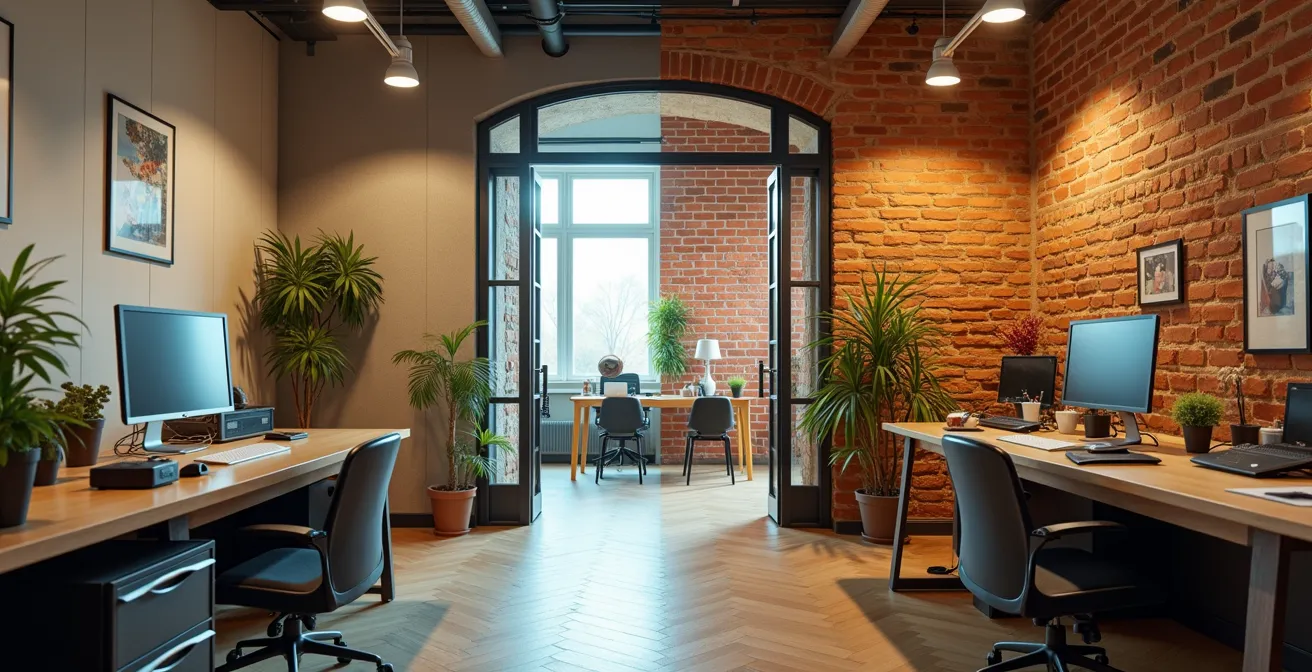
The image of a sterile government office juxtaposed with a vibrant creative space is a powerful metaphor for the choice facing many Ottawans. You can remain in the familiar, structured world, or you can step through the door into a more dynamic and personally fulfilling one. This scene isn’t exclusive or inaccessible; it’s actively looking for new members. It thrives on collaboration and new energy. Engaging with it doesn’t require you to be an artist or a tech genius; it simply requires curiosity and a willingness to explore a different side of the city after dark.
By seeking out these indie hubs, you’re not just finding something to do in the evening; you’re finding your people and, in the process, co-creating the future culture of the city.
How to Find a Quiet Coworking Spot in the Business District?
For many struggling with the “government town” mindset, the problem is a lack of separation. Working from home blurs the lines between professional and personal life, while working in a large, impersonal government building can feel stifling. A coworking space offers a powerful solution: a dedicated, professional “third place” that is neither home nor your primary office. It provides the structure and amenities of an office without the bureaucracy and social pressures, making it an ideal environment for focusing on a side hustle, studying, or simply having a quiet space to think outside of your usual four walls.
Finding the right coworking space in Ottawa’s business district, however, requires looking beyond just a desk and a Wi-Fi connection. The goal is to find an environment that matches the energy you want to cultivate. Are you a social entrepreneur looking to connect with other mission-driven individuals? Or are you a creative professional who needs soundproof booths and a vibrant, inspiring atmosphere? The city’s coworking scene has diversified significantly, offering a range of options tailored to different needs. Your choice of space is a form of identity architecture; it should be a place that reflects the person you want to be after 5 PM.
To help you navigate the options, it’s useful to compare some of the top spots in and around the downtown core. Each offers a unique atmosphere and set of features, catering to different types of professionals and creatives.
| Coworking Space | Location | Atmosphere | Key Features | Best For |
|---|---|---|---|---|
| Impact Hub Ottawa | Downtown Core | Social Innovation Focus | 16,000 sq.ft., 150+ members, SDG-focused programs | Social entrepreneurs, non-profits |
| Bayview Yards | 7 Bayview Station Road | Tech & Innovation Hub | 46,000 sq.ft., Prototyping Lab, Digital Media Lab | Tech startups, makers, innovators |
| CollabSpace | Downtown | Professional & Focused | Meeting rooms with smart TVs, reception services | Small teams needing structure |
| Coworkly | Multiple locations | Creative & Natural | Recording studio, soundproof booths, near LRT | Creative professionals, podcasters |
This comparison of leading coworking spaces highlights the diversity of options available. Spaces like Bayview Yards are more than just desks; they are epicenters of innovation, hosting hundreds of events and attracting a diverse mix of industry, academia, and investment communities. Choosing to work from such a location, even for a few hours a week, can expose you to new ideas and networks, effectively bursting the government bubble.
Don’t just look for a quiet desk. Look for a community. Look for a “third place” that energizes you and provides the professional separation you need to reclaim both your focus and your freedom.
Key takeaways
- The “government town” feeling is a mindset trap reinforced by a monotonous daily geography, not a reflection of Ottawa itself.
- Breaking free requires a conscious strategy of “identity architecture” by creating a life and purpose outside your professional title.
- The most effective method is the “Third Place Principle”: proactively discovering and frequenting social spaces that are neither home nor work to build new connections and perspectives.
Where to Find the Best “Third Places” for Meeting Locals in Ottawa?
You’ve understood the problem and embraced the strategy. Now comes the most exciting part: the execution. Finding your “third places” is an act of exploration. It’s about intentionally stepping off your well-worn path and into the spaces where the city’s true pulse can be felt. These are the places where conversations aren’t about the latest Treasury Board directive, but about art, music, community projects, and shared passions. This is where you stop being a job title and start being a local. The current tension around return-to-office policies, with polling showing that 57% of Ottawa workers oppose the mandate, highlights a deep-seated desire for a life not dictated by the downtown core. This is the perfect moment to build that life.
The best third places are often activity-based. They create a natural context for interaction that bypasses the awkwardness of typical networking. When you’re trying to solve a bouldering problem at a climbing gym like Altitude or Coyote, your job title is the last thing on anyone’s mind. The shared activity becomes the foundation for connection. Similarly, attending a niche event, like a pinball tournament at House of TARG, creates an instant, low-pressure social environment built around fun, not business cards.
Don’t be afraid to cross the bridge. A simple geographic shift into Quebec can feel like entering a different world. Places like Le Troquet in Vieux-Hull or the British Hotel in Aylmer offer a distinct atmosphere and a chance to immerse yourself in a different cultural milieu. These aren’t just bars or restaurants; they are cultural institutions with their own regulars and rhythms. By becoming a familiar face in one of these spots, you’re not just finding a place to go; you’re joining a community. This is the essence of bubble bursting: actively seeking out experiences that challenge your default settings and broaden your social horizons.
Your Checklist: Finding Ottawa’s Best Third Places
- Join Activity-Based Communities: Try Altitude or Coyote climbing gyms. The shared physical challenge forces interaction beyond work talk.
- Cross the River to Quebec: Visit Le Troquet in Vieux-Hull for a vibrant, francophone artsy crowd, or the historic British Hotel in Aylmer for a distinct local atmosphere.
- Attend Recurring Niche Events: Check out the calendar at House of TARG. Pinball and perogies create a perfect low-pressure socializing environment.
- Connect with the Creative Community: Visit the Enriched Bread Artists (EBA) studios during their open house events to meet local artists and see a different side of the city’s culture.
- Explore Local Markets and Cafés: Become a regular at a coffee shop or market outside of the downtown core, like in Hintonburg or Westboro, to soak in a different neighbourhood vibe.
Your new life after 5 PM is out there waiting. It’s not in a different city or a different job. It’s a 15-minute bike ride away, in a crowded café, on a climbing wall, or in a noisy pinball bar. Your escape begins the moment you decide to take a different turn on your way home.
Frequently Asked Questions on Managing Work-Life Boundaries
How can I create a transition between work and home?
For those commuting, the ride home provides crucial decompression time. Use this period to shift your mindset. Once you arrive home, take five minutes to do something relaxing—like listening to a song or stretching—before you start your evening routines.
What if I work from home and struggle with boundaries?
Having a physically separate office or workspace is the most effective way to separate work and home life. If you work in a shared space, make a ritual of tidying up all your work materials at the end of the day. Putting your laptop and papers away signals to your brain that work is over and helps you avoid the temptation to continue working.
How important are breaks and vacation time?
They are fundamentally important. You should take short breaks throughout your workday to rest and recharge your focus. Vacation time is also critical for long-term well-being and is an ideal opportunity for self-care activities that completely remove you from the work mindset.