
The best maple syrup souvenir isn’t the one in the prettiest bottle; it’s the one you choose with purpose, understanding its flavour profile and provenance.
- Syrup grades (Golden, Amber, Dark) are not quality levels but flavour profiles, each suited for different culinary uses.
- Buying directly from producers at Ottawa’s farmers’ markets guarantees authenticity and is significantly cheaper than airport or tourist shops.
Recommendation: Prioritize syrup in tin cans for safe travel and buy from a producer-only market like Lansdowne or Westboro for the best value and quality.
Stepping into a souvenir shop in Ottawa, you’re greeted by a wall of maple syrup. Gleaming glass bottles shaped like maple leaves sit next to traditional tin cans, all promising an authentic taste of Canada. For the average tourist, the choice is overwhelming. The common wisdom is to grab the prettiest bottle or whatever is available at the airport duty-free. But as any specialty food buyer knows, true quality and value lie beyond the packaging.
The goal isn’t just to bring home a souvenir; it’s to bring home the *right* souvenir. This means understanding that not all “Grade A” syrups are the same and that the container matters more for transport than for display. It involves looking past the convenient tourist traps to find the source, where generational knowledge and passion are boiled into every drop. This is about shifting your mindset from a tourist buying a trinket to a connoisseur selecting a fine food product.
This guide will walk you through that process. We’ll deconstruct the modern grading system, reveal the costly mistakes many travellers make, and pinpoint exactly where in Ottawa you can find the best products directly from the people who make them. You’ll learn to think about maple syrup not just as a sweet topping, but as a versatile ingredient with its own terroir and character, ensuring the gift you bring home is a true reflection of Canadian quality.
To help you navigate these choices like an expert, this article breaks down everything you need to know. From decoding flavour grades to smart packing strategies, consider this your insider’s guide to buying authentic Ottawa maple syrup.
Summary: Your Guide to Choosing Authentic Maple Syrup in Ottawa
- Why “Golden” Syrup Is Not Always Better Than “Dark” for Cooking?
- How to Pack Maple Syrup in Checked Luggage Without Breakage?
- Maple Butter or Maple Jelly: Which Is the Better Toast Topping?
- The Duty-Free Mistake That Costs You 30% More on Syrup
- Where to Store Open Maple Syrup to Prevent Crystallization?
- Why “Producer-Only” Markets Matter for Your Wallet and Health?
- Why Hotel Prices Triple During the Tulip Festival?
- Which Ottawa Farmers Market Has the Best Local Produce Deals?
Why “Golden” Syrup Is Not Always Better Than “Dark” for Cooking?
One of the biggest misconceptions about maple syrup is that “Golden” is the highest quality. The modern grading system isn’t a pyramid of quality but a spectrum of flavour. The grade simply tells you about the syrup’s colour and taste intensity, which is determined by when the sap was harvested. Thinking like a food buyer means matching the grade to the intended use.
Here’s how to pair the grade to the gift recipient’s personality:
- For the Breakfast Lover: Choose Amber-Rich grade. This is the classic, balanced maple flavour most people associate with pancakes. It’s versatile and a perfect all-rounder.
- For the Foodie or Chef: Select Dark-Robust grade. Harvested later in the season, it has a more pronounced, caramelized flavour that stands up beautifully in glazes, marinades, and complex sauces. Local Ottawa restaurants increasingly prefer these darker grades for sophisticated desserts.
- For the Baker: Opt for Very Dark-Strong grade. Its intensity is perfect for baking, as the maple flavour won’t get lost among other ingredients.
- For the Cocktail Enthusiast: Pick Golden-Delicate grade. Its light, subtle sweetness complements spirits without overpowering them, making it ideal for craft cocktails.
Ultimately, all 100% pure maple syrup grades offer the same nutritional benefits. The “best” one is simply the one that best fits the culinary application, making a grade-specific choice a much more thoughtful gift.
How to Pack Maple Syrup in Checked Luggage Without Breakage?
Bringing maple syrup home safely is a major concern for travellers. The beautiful glass leaf bottles that look so appealing on the shelf are also the most fragile. A savvy buyer prioritizes “packaging-for-purpose,” focusing on secure transport over delicate presentation. Your two best friends for travel are tin and plastic.
Tin cans are the traditional and arguably best option. They are lightweight, durable, and completely block out light, which helps preserve the syrup’s flavour. Plastic jugs are even lighter and virtually unbreakable, making them a worry-free choice, especially for larger quantities. If you absolutely must have a glass bottle for its gift-worthy appearance, wrap it meticulously. Place it in a sealable plastic bag, cushion it with multiple layers of clothing, and position it in the very centre of your checked suitcase, surrounded by soft items.
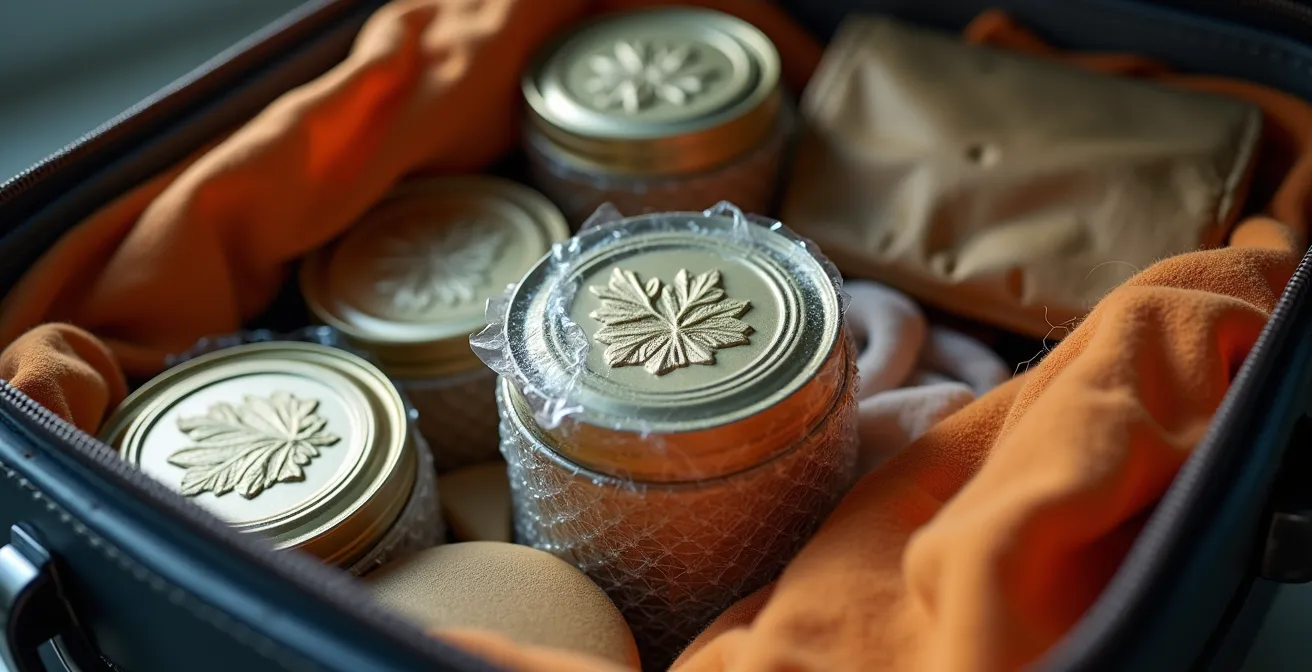
Remember that liquid restrictions are strict. According to Canadian Air Transport Security Authority (CATSA) regulations, any container larger than 100 ml (3.4 oz.) must be placed in checked luggage. Small 100ml bottles are allowed in your carry-on and can make for a great “emergency” gift if you’re short on space, but for anything larger, checking it is mandatory.
| Container Type | Break Risk | Weight | TSA/CATSA Rules | Best For |
|---|---|---|---|---|
| Glass Leaf Bottle | High | Heavy | Must be in checked luggage if >100ml | Display gifts |
| Tin Can | Low | Light | Must be in checked luggage if >100ml | Safe transport |
| Plastic Jug | Very Low | Lightest | Must be in checked luggage if >100ml | Family size |
| 100ml Mini Bottle | Medium | Minimal | Allowed in carry-on | Emergency backup |
Maple Butter or Maple Jelly: Which Is the Better Toast Topping?
Beyond syrup, Ottawa’s markets offer a delightful array of other maple products. Two of the most popular are maple butter and maple jelly, but they serve very different purposes and travel needs. Choosing between them depends on your gift-giving goals and logistics.
Maple Butter, also known as maple cream, is a revelation for those who’ve never tried it. It’s made from 100% pure maple syrup that has been heated, cooled, and whipped into a creamy, peanut-butter-like consistency. Its texture is divine on toast, scones, or crêpes. However, its high uniqueness factor comes with a catch: it’s less stable. It has a shorter shelf life and should be refrigerated after opening to maintain its texture. It’s the perfect gift for a true foodie who will appreciate its unique character and use it quickly.
Maple Jelly is more familiar in format. It has the clear, gel-like texture of a traditional fruit jelly but with a distinct maple flavour. Its primary advantage is stability. It has a long shelf life and does not require refrigeration until opened, making it a much safer and more convenient travel companion. It’s a great, low-risk introduction to maple products for someone less adventurous. Some local producers in the Ottawa Valley, like Fortune Farms, often pair maple butter with pancake mix in gift sets to create a complete breakfast experience that travellers can share back home.
This table breaks down the key differences to help you decide on the best gift:
| Factor | Maple Butter | Maple Jelly |
|---|---|---|
| Texture | Creamy, spreadable | Clear, gel-like |
| Shelf Life | 6 months refrigerated | 1+ year unrefrigerated |
| Travel Stability | Requires cool storage | Stable at room temp |
| Uniqueness Factor | High – less known outside Canada | Medium – more familiar format |
| Price Range | $12-18 CAD per jar | $10-15 CAD per jar |
The Duty-Free Mistake That Costs You 30% More on Syrup
The most common and costly mistake tourists make is waiting to buy maple syrup at the airport. While convenient, duty-free shops and tourist-centric stores in areas like the ByWard Market often have significant markups. You are paying a premium for convenience, not quality. A specialty food buyer knows that the best value is found by going directly to the source or as close to it as possible.
In Ottawa, this means visiting the farmers’ markets. Here, you buy directly from the producers or their families, cutting out the middlemen and their associated costs. You can often save 30-50% compared to souvenir shops. More importantly, you get a superior product with full traceability. You can ask the vendor which day the syrup was boiled, what part of the season it came from, and even see pictures of their sugar bush. This is the “producer-to-pantry” value chain in action. With Ontario producing about 2.68 million litres of maple syrup, there is an abundance of high-quality, locally-made product available without resorting to overpriced airport stock.
Buying direct also supports the local economy and the small, multi-generational family farms that are the backbone of the industry. You’re not just buying syrup; you’re buying a piece of local heritage.
Your Ottawa Maple Syrup Buying Checklist
- Source Identification: Prioritize buying from producers at Lansdowne Farmers’ Market (Sundays) or Westboro Market (Saturdays) for authenticity and fair pricing.
- Packaging for Transport: Choose sturdy tin cans over fragile glass bottles for your checked luggage. Ask if the vendor offers complimentary bubble wrap.
- Timing Your Purchase: Visit markets early in the day to avoid crowds, especially during festival seasons, and to ensure the best selection.
- Cost-Benefit Analysis: Only use airport duty-free for last-minute, sub-100ml gifts. The cost savings at a local market for larger quantities are substantial.
- Product Inquiry: Ask the producer about the harvest time (early season for Golden/Delicate, late season for Dark/Robust) to choose the right flavour profile for your gift.
Where to Store Open Maple Syrup to Prevent Crystallization?
Your responsibility as a gift-giver doesn’t end at the purchase. Providing proper storage instructions ensures your thoughtful present is enjoyed at its best quality. Maple syrup is a natural product without preservatives, and improper storage can lead to crystallization or spoilage. The key is to treat it like any other perishable food once it’s opened.
Unopened containers of maple syrup are shelf-stable for years. Producers utilize a process of hot-packing syrup at 85°C (185°F), which sterilizes the container and its contents. You can keep unopened tins or jugs in a cool, dark place like a pantry. However, the moment the seal is broken, the clock starts ticking. The best place for an opened container of maple syrup is the refrigerator. This slows down water evaporation, which is the primary cause of sugar crystallization, and inhibits the growth of mould.
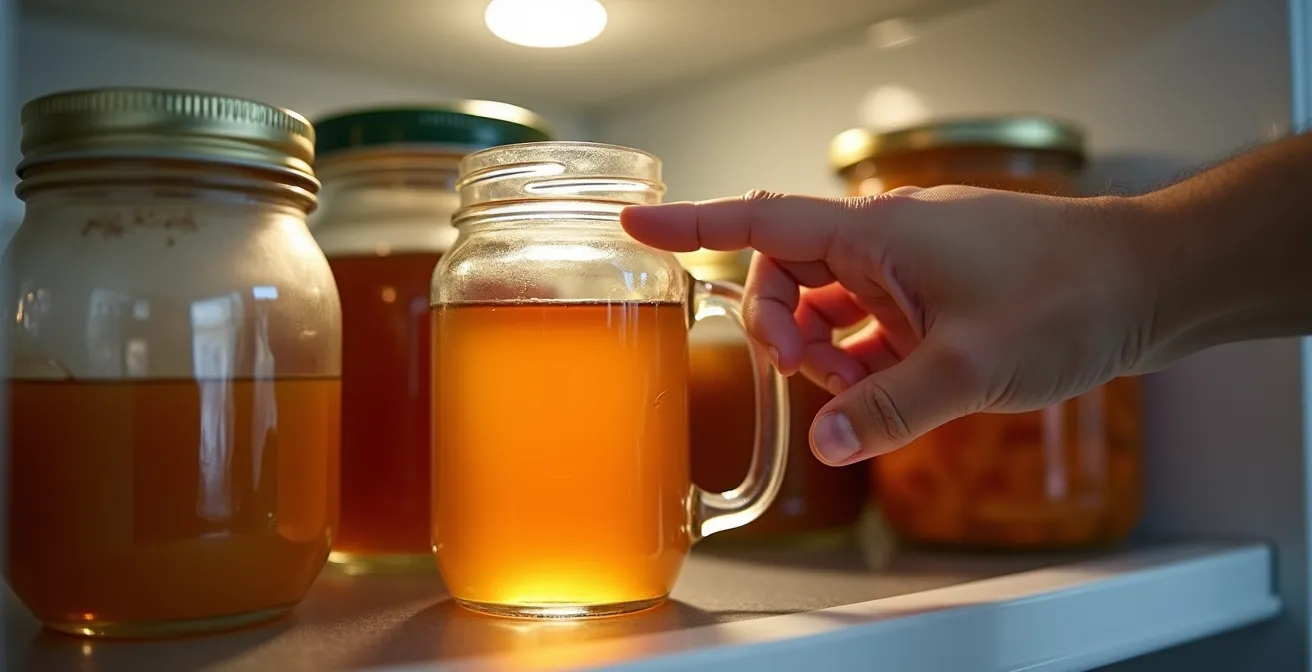
If you’ve purchased syrup in a tin can, it’s best practice to transfer the contents to a clean glass jar with a tight-fitting lid after opening. This prevents the syrup from developing a metallic taste over time. If you do find that your syrup has crystallized, don’t throw it out! Simply place the sealed container in a pan of hot (not boiling) water until the crystals dissolve. When giving syrup as a gift, consider adding a small note with a simple instruction: “Please refrigerate after opening for best quality.”
Why “Producer-Only” Markets Matter for Your Wallet and Health?
In Ottawa, not all markets are created equal. While the famous ByWard Market is a vibrant hub, it features a mix of producers and resellers. For the discerning buyer, “producer-only” markets like the one at Lansdowne Park (Sundays) and in Westboro (Saturdays) are the gold standard. The “producer-only” rule means the person selling the product is the person who made it, grew it, or raised it. This direct connection is the cornerstone of trust and quality in the local food scene.
For your wallet, this model is a clear winner. By eliminating the reseller, you avoid an entire layer of markup. The price you pay is a fair reflection of the production cost and a small profit for the farmer, not an inflated figure designed to profit multiple intermediaries. This is why prices at producer-only markets are consistently lower than at tourist shops or grocery stores for a product of equivalent or superior quality.
For health and peace of mind, the benefit is traceability. When you buy from a multi-generational operation like Fulton’s Pancake House & Sugar Bush or Fortune Farms at the Lansdowne Market, you can be certain you are getting 100% pure, unadulterated maple syrup. There’s no risk of it being blended with cheaper syrups or corn syrup, a concern that can arise with unverified resellers. You are buying directly from stewards of the forest, whose family name is on every bottle and whose livelihood depends on their reputation for quality.
Why Hotel Prices Triple During the Tulip Festival?
This title is a slight misnomer; the real issue for a maple syrup buyer is how to navigate a peak tourist season like Ottawa’s famous Canadian Tulip Festival. When the city is flooded with visitors, crowds swell, and the pressure to make quick, convenient purchases increases. However, this is precisely when smart buying strategies pay the biggest dividends.
During festival season, avoid the pop-up souvenir tents near the main tulip displays at Commissioners Park. Instead, stick to the plan of visiting a producer-only farmers’ market. The key is to go early. Arrive at the Lansdowne or Westboro market right when they open to get the best selection and have a chance to speak with vendors before the crowds descend. Many producers, aware of the tourist influx, create special products for the season, such as tulip-shaped maple candies or special-edition bottles, which make for a unique and timely gift.
If your schedule is tight, consider a visit to the Vanier Sugar Shack (Museopark). It’s the only operating sugar shack in a North American urban setting, located just a few kilometres from downtown Ottawa. It offers an authentic sugar bush experience without the long drive, making it a perfect excursion to combine with festival-going. Planning ahead is crucial; if you want to visit a sugar bush during these peak weeks, booking in advance is highly recommended.
Key Takeaways
- Syrup grades are about flavour, not quality. Match the grade (Golden, Amber, Dark) to the culinary use for a more thoughtful gift.
- For safe travel, choose durable tin cans or plastic jugs over fragile glass bottles, and remember that anything over 100ml must be in checked luggage.
- Get the best value and guaranteed authenticity by buying directly from producers at Ottawa’s farmers’ markets, saving 30-50% over tourist shops.
Which Ottawa Farmers Market Has the Best Local Produce Deals?
For a tourist on a mission to find the best maple syrup, the answer to “which market is best?” depends on your priorities: authenticity, variety, or convenience. Ottawa’s market ecosystem offers distinct options, each with its own strengths. As a buyer focused on quality and value, your best bet lies with the producer-only venues.
The Lansdowne Farmers’ Market (Sundays, year-round) is arguably the top choice for authenticity. It hosts renowned producers like Fortune Farms and Fulton’s, guaranteeing you’re buying directly from the source. The Westboro Market (Saturdays) operates under the same producer-only guarantee, offering a fantastic and slightly less crowded alternative. For a more rural experience, the Carp Farmers’ Market on the city’s outskirts provides access to smaller, local producers.
In contrast, the ByWard Market (daily) offers unparalleled variety and convenience due to its central location and long hours. However, you must be a more discerning shopper here, as it’s a mix of producers and resellers. While you can find excellent products, you need to ask questions to verify the source. This market landscape is a microcosm of Canada’s massive maple industry, which saw exports of maple products amount to $715.9 million in 2024. By choosing a producer market, you tap directly into this rich heritage.
| Market | Best For | When | Key Vendors |
|---|---|---|---|
| Lansdowne Market | Authenticity & Producer Direct | Sundays year-round | Fortune Farms, Fulton’s |
| ByWard Market | Variety & Tourist Convenience | Daily | Mix of producers/resellers |
| Carp Farmers Market | Rural Experience | Saturdays (seasonal) | Local small producers |
| Westboro Market | Producer-Only Guarantee | Saturdays | Rotating local vendors |
Armed with this knowledge, you are no longer just a tourist buying a souvenir. You are an informed buyer ready to select an authentic, high-quality, and fairly-priced taste of Ottawa’s local terroir. The perfect maple syrup gift is waiting for you—not on a duty-free shelf, but at a bustling market stall, offered by the very person who crafted it.