
The secret to a restorative 48-hour getaway from Ottawa isn’t choosing the perfect destination; it’s mastering the logistics of disconnection.
- Strategic planning for packing and travel times eliminates the most common sources of weekend stress.
- Sequencing your activities, from wineries to hikes, maximizes enjoyment and minimizes backtracking.
Recommendation: Shift your focus from *where* you’re going to *how* you’ll experience it, starting with a plan to conquer traffic and packing before you even leave.
You feel it by Thursday afternoon—that itch for a change of scenery, for a break from the routine of the city. You want a vacation, but a long drive or a flight is out of the question. The solution seems simple: a quick 48-hour adventure in the region. So you pick a spot, throw a bag in the car, and go. But often, the reality is a frustrating loop of traffic, realizing you packed the wrong shoes, and a Sunday evening return that leaves you more exhausted than when you left. The “escape” never quite materializes.
Many guides will give you a list of lovely places near Ottawa, from the quaint streets of Merrickville to the hills of the Outaouais. They’ll tell you to “pack layers” and “book ahead.” While true, this advice misses the fundamental point. These short trips often fail not because the destination is wrong, but because the execution is flawed. The friction of the journey erodes the feeling of escape.
But what if the key to that “vacation feel” wasn’t about adding more kilometres to the odometer, but about subtracting logistical friction? This is the principle of the logistics of disconnection. A truly great short trip is an exercise in thoughtful planning that makes the experience seamless, turning a simple weekend into a genuine mental reset. It’s about understanding the specific rhythms of the Ottawa region—the traffic patterns, the activity clashes, the hidden opportunities.
This guide is built on that philosophy. We won’t just list destinations; we will deconstruct the anatomy of a perfect 48-hour adventure. We’ll show you how to pack for two completely different experiences, how to sequence your day for maximum enjoyment, and how to avoid the specific travel traps that every Ottawa resident knows too well. Get ready to plan a weekend that actually feels like a vacation.
To help you craft this perfect short-haul adventure, we’ve broken down the essential logistical questions you need to answer. This plan will guide you through the strategic decisions that make all the difference between a stressful weekend and a truly restorative escape.
Summary: Planning Your 48-Hour Ottawa Region Adventure
- Why Wakefield Feels Like a Different Country Just 30 Minutes Away?
- How to Pack for a Weekend That Includes Hiking and Fine Dining?
- Carp vs Merrickville: Which Village Is Better for Antique Shopping?
- The Sunday Return Mistake That Traps You on Highway 417
- In What Order Should You Visit the Wineries to maximize the Day?
- Why the “Wolf Trail” Rating Deceives Many Occasional Hikers?
- Why the Temperature Fluctuation in March Is Critical for Syrup?
- How to Rent a Kayak to See Rideau Falls From the Water?
Why Wakefield Feels Like a Different Country Just 30 Minutes Away?
The desire for an escape is often a desire for a different culture, not just a different location. This is Wakefield’s secret weapon. Just a 30-minute drive from downtown Ottawa, crossing the bridge into this Quebec village feels like a far more significant journey. The reason isn’t just the distance; it’s the powerful psychological barrier created by Gatineau Park and the immediate cultural shift.
The park acts as a vast, green buffer, severing the visual and mental ties to Ottawa’s urban grid. Once you’re on Highway 5, surrounded by the dense forests of the Outaouais, the city dissolves behind you. This isn’t just a drive; it’s a transition. Upon arrival in Wakefield, the shift is confirmed: French-first signage, charming “dépanneurs” instead of chain convenience stores, and a distinct architectural style rooted in its history as a logging village. This immediate immersion into a different rhythm and language is what tricks your brain into feeling like you’ve travelled for hours, not minutes.
The Gatineau Park Buffer Effect
Gatineau Park, a massive 90,000-acre conservation area, creates a distinct sense of separation that enhances Wakefield’s appeal as an escape. Its proximity, just 15 minutes from Ottawa, offers year-round activities that serve as a prelude to the village’s charm. As noted in local tourism analyses, this park effectively preserves Wakefield’s unique Quebec character by physically and psychologically separating it from Ottawa’s urban sprawl, making the short drive feel like a genuine retreat into nature. This buffer ensures the village maintains its relaxed pace and arts-focused economy, a stark contrast to the nearby tech hubs of Kanata.
To truly appreciate this shift, embrace the differences. Start your morning with a coffee and a croissant from a local boulangerie, browse the artist-run galleries that are the backbone of the village economy, and enjoy a beer on a patio overlooking the Gatineau River. It’s these small, culturally distinct experiences that create the “vacation feel” so close to home. You’re not just visiting another town; you’re stepping into a different way of life, and that’s the most powerful form of escape.
How to Pack for a Weekend That Includes Hiking and Fine Dining?
The ultimate Ottawa-area weekend often involves a delightful contradiction: a rugged morning hike through Gatineau Park followed by an elegant dinner in a village bistro. This presents a classic packing dilemma. Overpacking means clutter, but underpacking means being unprepared. The solution lies in a dual-purpose strategy, centered on versatile pieces and a smart “car trunk transition system.”
Instead of packing two separate wardrobes, think in layers and adaptable items. The cornerstone of this approach is multi-purpose footwear. A pair of quality leather boots like Blundstones can handle a moderate trail and still look appropriate for casual dining, saving you critical space. The second key is focusing on technical fabrics that don’t scream “outdoors.” Merino wool is a hero here; it’s a natural temperature regulator for hiking but drapes well enough for a restaurant. Quick-dry pants are another excellent choice, allowing you to go from trail to terrace with a simple shoe and shirt change.
This paragraph introduces the concept of a versatile wardrobe. To help you visualize this, the illustration below showcases how technical and stylish gear can coexist in a well-organized travel setup.
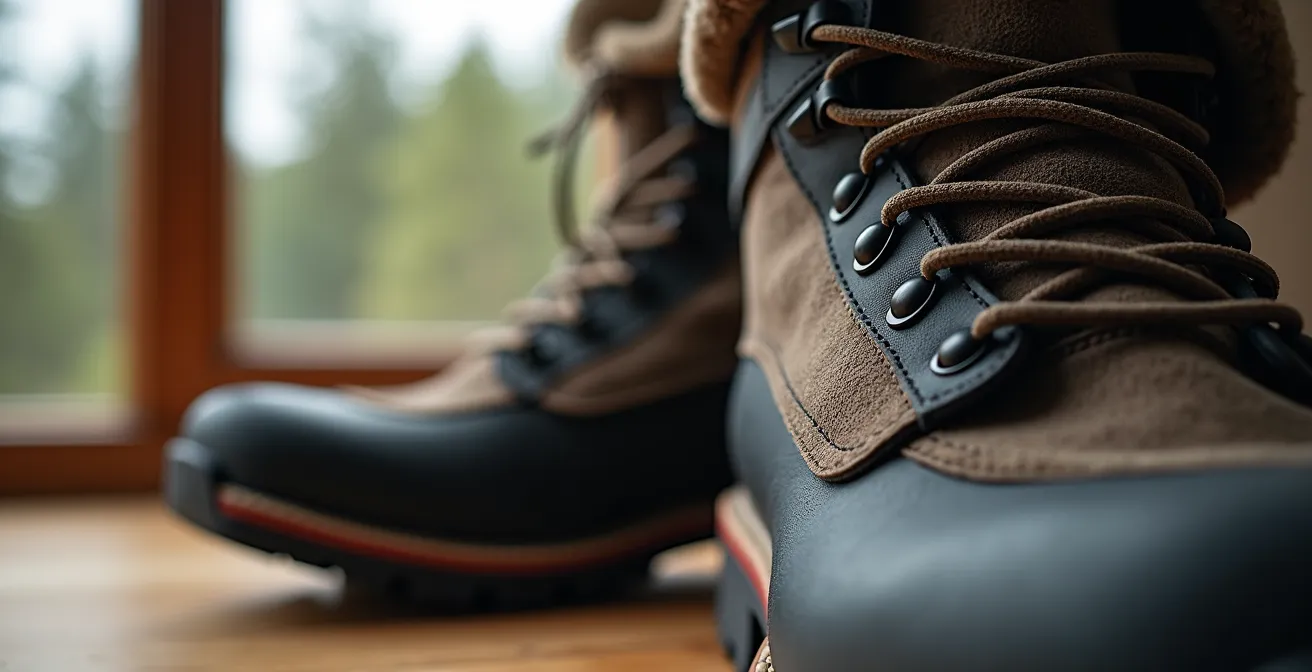
As you can see, the key is choosing items with a clean aesthetic. A packable waterproof jacket in a neutral colour can serve as a rain shell on the trail and a sleek outer layer in the evening. The final piece of the puzzle is your transition system: use separate bins or bags in your trunk for muddy gear and clean evening wear. This small organizational step prevents your car from becoming a chaotic mess and makes the switch from “hiker” to “diner” feel effortless and civilized.
Action Plan: Audit Your Adventure Wardrobe
- Footwear Review: Identify your most versatile pair of shoes. Can they handle a forest path and a restaurant floor? If not, this is your first investment.
- Fabric Check: Go through your outdoor and casual tops. Pull out any merino wool, or stylish technical fabrics. These are your core pieces.
- The Pant Test: Do you own pants that are comfortable enough for a walk but structured enough for dinner? If not, look for “travel pants” or “technical chinos.”
- Jacket Versatility: Evaluate your jackets. Do you have one that is both weather-resistant and has a clean, simple design suitable for an evening out?
- System Setup: Designate two specific bags or bins for your car: one for “Dirty/Trail” and one for “Clean/Town.” Commit to using them.
Carp vs Merrickville: Which Village Is Better for Antique Shopping?
For many, a weekend escape isn’t complete without a bit of treasure hunting in the region’s antique shops. Two prime destinations near Ottawa offer very different experiences: Carp and Merrickville. Choosing between them isn’t about which one is “better” in absolute terms, but which one aligns with the kind of day you want to have and, critically, on which day of the week you plan to go.
Carp is a Saturday destination, anchored by its famous farmers’ market. The vibe is bustling and eclectic. The antique opportunities are clustered around the market itself and the main village strip. It’s an experience built around a central, lively event. You can combine your antique hunting with grabbing fresh produce, sampling local foods, and enjoying a vibrant, community atmosphere. It’s ideal for those who love a multi-activity day with a rustic, market feel. However, if you visit on a Sunday, you’ll find a much quieter village, with the market’s energy gone.
Merrickville, on the other hand, is a prime Sunday destination. Known as the “Jewel of the Rideau,” its charm lies in its beautifully preserved 19th-century streetscape. The antique shops are spread along St. Lawrence Street, interspersed with artisan boutiques and cafes. The experience is more of a leisurely stroll, a classic “main street” shopping day. Crucially, according to local tourism patterns, Merrickville’s shops maintain robust Sunday operations, making it the superior choice when Carp’s main attraction is closed. It caters to the browser who wants to wander from shop to shop in a picturesque, historic setting.
The decision is a strategic one. If your weekend plan has you free on Saturday and you enjoy a lively, market atmosphere, head to Carp. If Sunday is your designated shopping day and you prefer a more traditional, charming village stroll, Merrickville is the clear winner. Choosing correctly ensures you arrive to open doors and a welcoming atmosphere, not a sleepy town on its day off.
The Sunday Return Mistake That Traps You on Highway 417
Nothing shatters the calm of a perfect weekend getaway faster than being stuck in bumper-to-bumper traffic on the way home. For Ottawa residents, this scenario is painfully familiar. The biggest mistake you can make is joining the westbound crawl on Highway 417 between 3 PM and 7 PM on a Sunday. This predictable traffic jam, which can be called the “Cottage Country Crush,” is a weekly phenomenon that can add an hour or more to your return journey and undo all your hard-earned relaxation.
This congestion is caused by a perfect storm of returning travellers: cottagers from the Valley, day-trippers from Gatineau, and weekenders from villages like Carp and Almonte all converge on the same artery at the same time. Simply knowing about this peak window is half the battle. The other half is having a strategic plan to avoid it entirely. Blindly following your GPS into this trap is a rookie error.
Anatomy of the “Cottage Country Crush”
The predictable Sunday afternoon congestion on Highway 417 is a well-documented issue. This “Cottage Country Crush” consistently clogs the highway between 3 PM and 7 PM as travellers from the Ottawa Valley and Gatineau Park head back to the city. Data from regional travel analysts confirms this pattern, showing that the convergence of these groups creates significant delays. However, the same analysis also reveals that alternative routes like March Road can reduce travel time by up to 30 minutes during these peak hours, offering a strategic advantage to informed drivers.
Your best defence is a tactical detour or a strategic delay. Instead of fighting the traffic, sidestep it. Routes like Old Carp Road or March Road offer a more scenic and often faster alternative to the 417’s parking lot. If you’re returning from Quebec, use the Macdonald-Cartier Bridge and take the beautiful Sir John A. Macdonald Parkway along the river. An even better strategy is to outsmart the clock. Don’t leave your destination at 2:30 PM with everyone else. Instead, plan one “last stop” activity. Visit the Diefenbunker Museum, have a late and leisurely lunch, or go for one final short walk. By leaving after 7 PM, you’ll trade an hour of stressful traffic for an hour of enjoyable activity, arriving home relaxed.
In What Order Should You Visit the Wineries to maximize the Day?
A day trip through the burgeoning wine country around Ottawa is a fantastic way to spend a Saturday or Sunday, but a great wine tour is more than just a list of addresses. To truly maximize the experience, you need a logistical plan: the “Sun and Palate Strategy.” This approach considers two crucial factors: your palate is freshest in the morning, and you want to end your day closer to home, not further away.
The common mistake is to start at the winery closest to Ottawa and work your way out. This is logistically backward. It means your longest drive is at the end of the day when you’re most tired. The superior strategy is to start at the furthest point and work your way back. For a tour of the wineries south-east of Ottawa, this means beginning your day at a location like Jabulani Vineyard near Richmond. You’ll tackle the longest drive with fresh energy and arrive with a clean palate, ready to appreciate the subtle notes of the first tasting.
From there, your path should create a logical trail back toward the city. Schedule a midday stop at a winery that offers food, like Stone Crop Acres Winery, to break up the tastings and give your palate a rest. The most critical logistical step in the post-2020 era is to book all your tasting appointments in advance. Spontaneity is no longer a viable option, especially on a weekend; showing up without a reservation will likely lead to disappointment. Your final stop should be the one closest to home, such as KIN Vineyards near Carp, allowing for a beautiful sunset tasting before a short and easy drive back to Ottawa.
This image captures the serene atmosphere you can enjoy when your day is well-planned, ending at a beautiful vineyard as the sun sets.
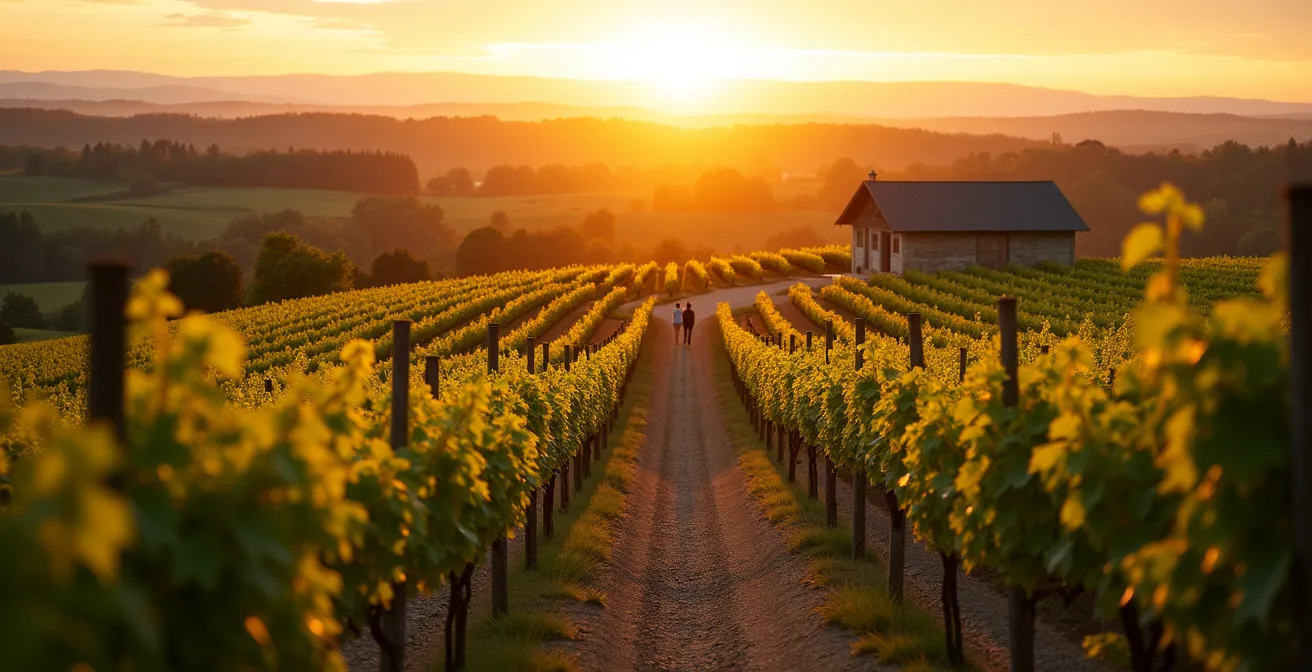
By following this simple “furthest first” logic, you create a seamless and relaxing day. Your driving time decreases as the day progresses, your palate is respected, and you end on a high note, close to home, with the warm glow of the sunset and a day of excellent local wine behind you.
Why the “Wolf Trail” Rating Deceives Many Occasional Hikers?
In Gatineau Park, Trail 62, famously known as the Wolf Trail, carries a reputation as one of the region’s best hikes. Its “difficult” rating might seem like a standard challenge, but this label can be dangerously deceptive for occasional hikers who are more accustomed to the flatter trails of Ottawa’s Greenbelt. The trail’s difficulty isn’t just about its 8km loop; it’s about the relentless elevation changes and rugged, rocky terrain that are uncommon for the immediate area.
Unlike many local paths that are wide and well-groomed, the Wolf Trail is a true mountain hike in miniature. The ascent is steep and sustained, demanding strong cardiovascular fitness. But the real challenge often comes on the descent, where rocky, uneven footing requires careful concentration and puts significant strain on the knees and ankles. The official rating system simply doesn’t capture this technical aspect. As noted by the National Capital Commission’s difficulty rating system, the trail features significant challenges that set it apart from typical regional hikes.
Many hikers, expecting a tougher version of a familiar trail, set out with inadequate footwear, not enough water, or too late in the day. They are then caught off guard by the physical demands and the time it actually takes to complete the loop (often 3-4 hours, not the 2 they might have guessed). The stunning lookouts are the reward, but they are earned through genuine effort. It’s a fantastic adventure, but one that requires respect and proper preparation.
The key takeaway is to treat the Wolf Trail not as just another Gatineau Park hike, but as a serious undertaking. Wear proper hiking boots with ankle support, pack more water and snacks than you think you’ll need, and budget ample time. Understanding that its “difficult” rating means “technically demanding and physically taxing” by local standards will ensure your adventure is memorable for the right reasons—the breathtaking views, not a twisted ankle.
Why the Temperature Fluctuation in March Is Critical for Syrup?
For a few fleeting weeks in March, the Ottawa region is captivated by the magic of maple syrup. We flock to sugar shacks like Fulton’s Pancake House to enjoy this iconic Canadian treat, but few understand the delicate meteorological dance required to produce it. The secret to the sap run isn’t just warmth; it’s the critical fluctuation between freezing nights and mild days. This cycle creates a natural “pressure-pump” mechanism inside the maple trees.
Here’s how it works: during the night, temperatures must drop below 0°C. This cold causes the gasses inside the tree’s wood fibres to contract and creates a suction effect, drawing water up from the roots into the trunk and branches. Then, as the daytime temperature rises above freezing, the warming gasses expand, building up pressure inside the tree. This pressure physically pushes the sweet, watery sap out through any opening—including the taps installed by syrup producers.
Without this day-night, freeze-thaw cycle, the pressure system fails, and the sap won’t flow. A string of days that are too warm or nights that don’t freeze can stop a sap run in its tracks. Producers are entirely at the mercy of the weather. This process is also incredibly resource-intensive; it takes an enormous amount of sap to create the final product. The sheer volume required highlights the magic of the process, as it illustrates the intensive process behind this local delicacy where approximately 40 litres of raw sap are needed for just 1 litre of syrup.
The Science of Sap Flow
The “pressure-pump” mechanism is a delicate natural process. It requires freezing nights (below 0°C) for the sap to contract and create a vacuum, followed by warm days (above 0°C) that build pressure and push the sugary liquid through the taps. Local producers must be vigilant, as a sudden, prolonged warm spell can be disastrous. It can trigger the trees to begin budding prematurely, which results in “buddy sap”—a cloudy, off-flavour syrup that is of a much lower grade and unsuitable for table use.
So when you pour that liquid gold onto your pancakes, you’re not just tasting sugar; you’re tasting the product of a precise and precarious natural phenomenon. It’s a delicious reminder that some of the best things in our region are a direct result of our unique, and often challenging, climate.
Key Takeaways
- Master the “car trunk transition system” by separating muddy gear from evening wear to make packing for diverse activities seamless.
- Avoid the “Cottage Country Crush” on Highway 417 by planning your Sunday return before 3 PM or after 7 PM, using scenic backroads as an alternative.
- Implement the “Sun and Palate Strategy” for wine tours: start at the furthest winery and work your way back towards Ottawa to save your palate and your energy.
How to Rent a Kayak to See Rideau Falls From the Water?
Seeing the magnificent Rideau Falls, where the Rideau River tumbles into the Ottawa River, is a classic Ottawa experience. But seeing it from land is one thing; appreciating its power and scale from water level is a completely different adventure. Renting a kayak offers a unique perspective, but success depends on a key logistical choice: where you rent from. This decision dictates the nature and difficulty of your journey.
You have two primary options. The first is renting from the Dow’s Lake Pavilion. This route offers a long, scenic paddle downstream along the historic Rideau Canal. The water is exceptionally calm, making it accessible for paddlers of all skill levels. It’s a journey through the heart of the city, passing beautiful homes and green spaces. The downside is the distance; it’s a significant paddle, so be sure to budget enough time for the round trip.
Your second option is renting from the Ottawa New Edinburgh Club, located on the Ottawa River just east of the falls. This provides much quicker access, but the journey is upstream against the river’s current. This requires more physical effort and is better suited for those with some paddling experience. The reward is a shorter trip and a different view, approaching the falls from the grand expanse of the Ottawa River. Whichever you choose, booking your rental in advance is highly recommended, especially on sunny summer weekends.
Once you approach the falls, safety is paramount. Keep a safe distance from the base where the water is turbulent and creates a “boil.” The best spot for a photo is often slightly to the east, near the French Embassy, where the morning light illuminates the cascading water beautifully. This vantage point, accessible only by water, transforms a familiar landmark into a personal and memorable discovery.
Now that you’re armed with the logistical knowledge to conquer traffic, packing, and activity planning, the final step is to put it all together. A successful 48-hour escape is a system, where each well-planned component supports the next, creating a seamless experience that allows for true disconnection. To start crafting your own perfect weekend, revisit the foundational concept of creating that all-important feeling of escape.