
The secret to a flawless spontaneous picnic in Ottawa isn’t finding the perfect view; it’s mastering the logistics of speed and scarcity after 5 PM.
- Legal alcohol consumption is now possible in specific parks, but requires knowing the strict rules and designated zones.
- Assembling a gourmet meal in 15 minutes and finding an available table are tactical skills that trump simply heading to a popular spot.
Recommendation: Ditch the idea of a perfect, empty park and embrace strategic picnicking—using insider knowledge to navigate crowds, time, and regulations to reclaim your summer evenings.
The clock strikes five, the summer sun is still high, and another perfect Ottawa evening feels like it’s slipping away behind a computer screen. The impulse is to grab a blanket, text a few colleagues, and head for the nearest patch of green. We’ve all been told the key to a great picnic is a scenic view and good company. But for the office worker, the reality of this 5 PM scramble is often a frustrating hunt for parking, crowded parks, and a hastily grabbed bag of chips for dinner.
This isn’t just about finding a pretty spot by the Rideau Canal. A truly successful after-work picnic is a masterclass in urban logistics. It involves navigating city bylaws on a whim, knowing which grocery aisles to hit for a meal that feels special but takes minutes to assemble, and understanding the subtle art of finding a quiet corner when everyone else has the same idea. It’s about turning the stress of scarcity—of time, space, and quiet—into a strategic advantage.
Forget the clichés. The perfect spontaneous picnic doesn’t just happen; it’s engineered. This guide is your new playbook. We’re moving beyond the obvious “go to Major’s Hill Park” advice to give you the operational intel you need. We’ll decode the new alcohol-in-parks pilot program, lay out a 15-minute gourmet grocery store strategy, and reveal the tactical thinking required to find a spot, avoid pests, and actually relax before the sun dips below the horizon.
Contents: How to Win the After-Work Picnic Game in Ottawa
- Why Can You Drink Alcohol in Some Parks Now and Not Others?
- How to Assemble a Gourmet Picnic from a Grocery Store in 15 Minutes?
- Nepean Point vs Dows Lake: Which Has the Best Sunset View for Dinner?
- The Wasp Trap Mistake That Ruins August Picnics
- Where to Find Picnic Tables That Are Actually Available at 5 PM?
- Why Are BBQs Banned in Some Parks But Encouraged in Others?
- How to Park at Lansdowne Market Without Paying Premium Rates?
- Which Ottawa Farmers Market Has the Best Local Produce Deals?
Why Can You Drink Alcohol in Some Parks Now and Not Others?
The ability to enjoy a beer or a glass of wine with your picnic is a game-changer for after-work relaxation, but it’s governed by very specific rules. The confusion arises from the City of Ottawa’s pilot program, which designates certain parks for legal alcohol consumption while others remain strictly off-limits. This isn’t a city-wide free-for-all; it’s a controlled experiment in public space usage. The key is knowing if your chosen spot is on the approved list and understanding the conditions.
The program is designed to balance relaxed enjoyment with public safety and order. That’s why you’ll find that alcohol is only permitted during specific hours (typically 11 a.m. to 9 p.m.) and only when accompanied by a meal. Furthermore, there are buffer zones: you must stay a set distance away from children’s play areas like playgrounds and splash pads. The pilot program’s success depends on public compliance, which is why the rules are precise.
For the 2025 season, the rules are clearer than ever. According to the city’s official announcement, the pilot program has a defined timeline, with the most recent iteration running from July 1 to October 31, 2025. Before you pack your cooler, your first step in picnic logistics should always be to check the latest list of participating parks on the City of Ottawa’s official website. Assuming a park is included because it’s large or popular is a common and costly mistake.
How to Assemble a Gourmet Picnic from a Grocery Store in 15 Minutes?
The difference between a sad bag of chips and a memorable al fresco dinner is preparation. But when you’re leaving the office at 5 PM, you don’t have time for extensive cooking. The solution is a tactical grocery store run. This means choosing a store with a high-quality prepared foods section and executing a precise shopping strategy. Your goal is to assemble, not to cook. Think of it as building a charcuterie board on the go.
Places like Farm Boy or the Loblaws at Rideau Centre are ideal for this mission. They are designed for this kind of quick, quality-focused shopping. The strategy is to divide and conquer: head straight for the deli and specialty counters. Avoid the main aisles. Your shopping list should focus on five key categories: an artisanal cheese, a signature dip (like hummus or tzatziki), pre-cut charcuterie and olives, a fresh baguette, and ready-to-eat fruit like grapes or berries. This combination requires zero prep and provides a balanced, satisfying meal.
The rising popularity of this elevated-yet-easy approach is evident in the local market. Just look at the success of services like Runaway Picnic, which won Ottawa’s BEST Experience Award. Their curated packages for everything from date nights to corporate events show a clear demand for high-quality, effortless outdoor dining. You can replicate this “luxury” feel yourself by focusing on a few premium items rather than a cart full of mediocre ones. A great cheese, fresh bread, and good company are the core of a fantastic picnic.
Nepean Point vs Dows Lake: Which Has the Best Sunset View for Dinner?
Choosing a location is the classic picnic dilemma, and in Ottawa, the sunset debate often comes down to two heavyweights: the iconic parliamentary vista from Nepean Point or the serene water reflections at Dows Lake. While both are beautiful, the “best” spot depends entirely on your priorities for the evening. It’s a choice between dramatic, landmark-focused views and a more natural, tranquil atmosphere. One is a tourist magnet, the other a local favourite.
To help you decide, let’s break it down with some strategic analysis. Nepean Point offers an unparalleled, elevated view of Parliament Hill, the Ottawa River, and the Gatineau Hills. It’s quintessentially Ottawa. However, this also makes it a top tourist destination, meaning crowds and competition for a good spot are high, especially at golden hour. Dows Lake, on the other hand, provides a calmer experience. The appeal here is the way the setting sun glints off the water, creating a dazzling, peaceful ambiance. It feels more removed from the city bustle.
To make the choice clearer, this scorecard compares the classic spots and adds a wildcard, Remic Rapids, for those looking to avoid crowds. The data on sunset times and directions can be confirmed through resources like the daily local sunset tracker.
| Criteria | Nepean Point | Dows Lake | Remic Rapids (Wildcard) |
|---|---|---|---|
| Sunset View Quality | Parliament backdrop | Water reflections | West-facing river views |
| 5 PM Crowd Factor | High (tourist spot) | Moderate | Low (hidden gem) |
| Parking Availability | Limited/Paid | Good/Free areas | Excellent/Free |
| Bug Index | Low (elevated breeze) | High (still water) | Low (river breeze) |
This comparison highlights a key principle of strategic picnicking: the most famous view isn’t always the best experience. Remic Rapids, for example, scores exceptionally well on practical metrics like parking and low crowds, making it a superior choice for a spontaneous, stress-free evening.

Ultimately, the visual debate between a parliamentary silhouette and shimmering water is personal. But when you factor in the logistics of the 5 PM scramble, a spot like Remic Rapids often emerges as the practical winner.
The Wasp Trap Mistake That Ruins August Picnics
Nothing shatters the peace of an August picnic faster than a swarm of wasps. In a desperate attempt to protect their food, many people deploy those familiar yellow DIY traps, often filled with something sweet. However, this common tactic is frequently the cause of the problem, not the solution. It’s a critical mistake in picnic logistics that can turn a pleasant evening into a frantic battle.
As wasp experts from Mr Wasp UK highlight, this strategy often backfires spectacularly:
DIY traps can actually have the complete opposite effect and lure wasps towards your picnic
– Mr Wasp UK, How to Stop Wasps From Ruining Your Picnic
By placing a sweet attractant right next to your blanket, you’re essentially sending an open invitation to every wasp in the vicinity. If you must use a trap, placement is everything. Pest control advice suggests you should place wasp traps at least 15-20 feet away from your dining area, creating a diversion rather than a central beacon. The goal is to draw them away from you, not into your personal space.
A better strategy is to focus on deterrents, not traps. According to Health Canada, several non-trap methods are far more effective for keeping your meal pest-free. Wasps are surprisingly sensitive to their environment. Simple changes can make your picnic spot much less appealing to them. For instance, wasps dislike strong air currents, so bringing a small, portable, battery-operated fan can create an effective no-fly zone around your food. Using fine mesh food covers is a physical barrier they can’t penetrate. It’s also wise to avoid sweet-smelling perfumes and to keep all garbage sealed tightly. These small, proactive steps are far more effective than a poorly placed, reactive trap.
Where to Find Picnic Tables That Are Actually Available at 5 PM?
One of the biggest challenges of the 5 PM scramble is resource scarcity, and the most coveted resource is often a simple picnic table. Arriving at a popular park only to find every table occupied is a common frustration. This forces you to either sit on damp ground or abandon your plans. The strategic picnicker, however, knows that the solution is either to find hidden-gem locations or to bring your own infrastructure.
The first tactic is to look beyond the obvious. Instead of heading to the main, crowded areas of Vincent Massey or Hog’s Back Park, explore their peripheries. Even better, consider unconventional locations. For example, the Carleton University campus offers beautiful spots along the river with tables that are often deserted in the summer, especially on evenings and weekends. These locations aren’t on the typical “Top Picnic Spots” lists, making them perfect for a quiet escape.
The second, and perhaps most empowering, tactic is to eliminate the search altogether by investing in a lightweight, portable picnic table. This simple piece of gear completely changes the game. It opens up countless possibilities, turning any patch of grass into a comfortable dining spot. You’re no longer competing for the park’s limited resources; you are creating your own. This is the ultimate expression of picnic freedom and efficiency.
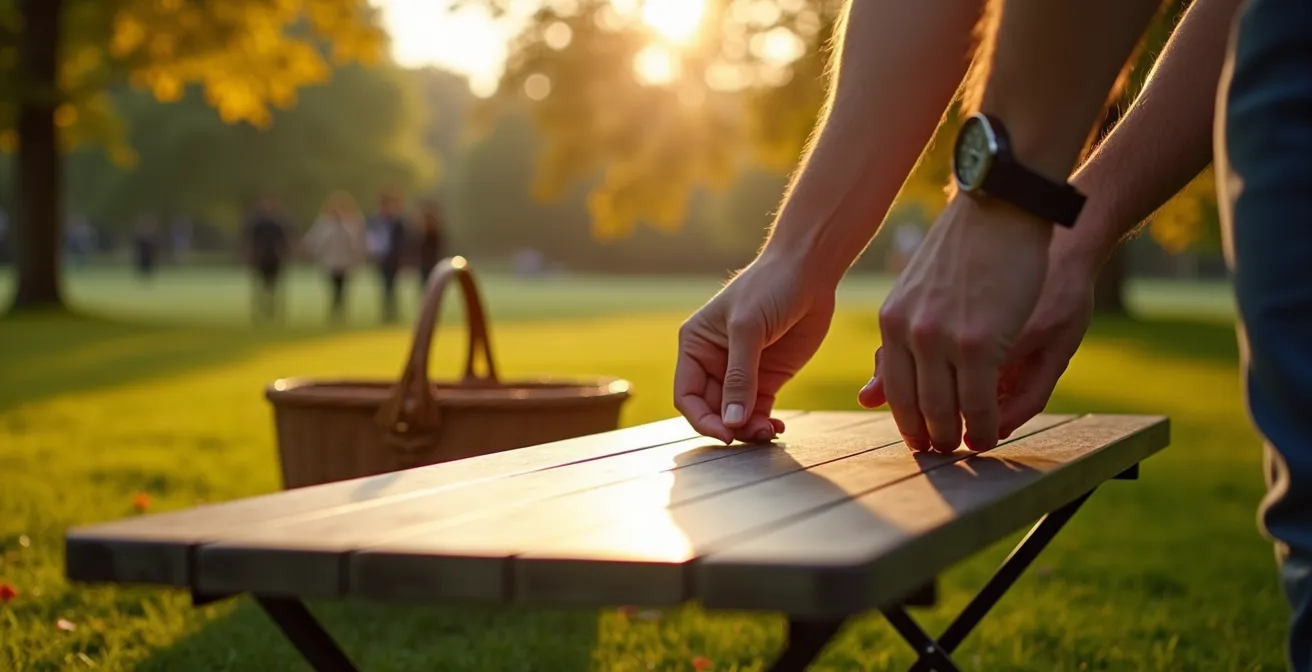
To find these hidden spots or identify a good area to set up your own table, a “digital scouting” strategy is invaluable. Before leaving work, use Google Maps’ satellite view to spot table clusters or quiet green spaces. According to the NCC, many Greenbelt sectors have sheltered picnic areas that are less frequented. This 5-minute digital reconnaissance can save you 30 minutes of frustrating driving and searching on the ground.
Why Are BBQs Banned in Some Parks But Encouraged in Others?
The tantalizing smell of a barbecue is a summer staple, but the rules governing them in Ottawa’s parks can seem arbitrary. You might see designated charcoal pits in one park while another has signs strictly forbidding any open flame. This difference isn’t random; it’s based on a clear-cut system of fire safety, park infrastructure, and fuel type. Understanding this system is key to planning a successful after-work grill session.
The primary distinction is between charcoal and propane. Charcoal BBQs produce embers and pose a higher fire risk, which is why their use is restricted to city-provided, fixed steel pits. These are typically found in larger, designated picnic areas like Mooney’s Bay or Vincent Massey Park. Propane BBQs, being more contained and controllable, are generally permitted in most city parks, provided there isn’t a city-wide fire ban in effect. The “ban” you see in some parks is often a ban on bringing your own charcoal grill, not on all cooking.
The challenge for the after-work picnicker is that the designated charcoal pits are a scarce resource and operate on a first-come, first-served basis. Arriving at 5:30 PM on a beautiful day almost guarantees they will all be taken. This makes a portable propane grill a much more strategic piece of equipment for spontaneous outings. Always remember to check the Ottawa Fire Services website for fire ban status before you head out, as this overrides all other park-specific permissions.
Your Go/No-Go BBQ Decision Checklist
- Fire Ban Check: First, verify the current city-wide fire ban status with Ottawa Fire Services. If a ban is active, all BBQs are a no-go.
- Fuel Type Decision: Determine your BBQ type. Is it charcoal (only usable in designated city pits) or propane (more widely permitted)?
- Park Verification: Cross-reference your chosen park with the city’s approved list for your specific BBQ type. Don’t assume.
- Charcoal Pit Reality Check: If planning to use a city charcoal pit, understand that demand is extremely high after 5 PM. Arrive early or have a backup plan.
- Speed Grilling Prep: As an alternative, pre-marinate thin-cut items (like skewers or minute steaks) that can be grilled on a propane unit in under 5 minutes.
Key Takeaways
- Spontaneous picnics succeed through logistical strategy, not just finding a pretty view.
- Knowing the specific rules for alcohol, BBQs, and parking in Ottawa is non-negotiable for a stress-free outing.
- Solving for scarcity—of time, tables, and quiet—by using intel and the right gear is the most effective approach.
How to Park at Lansdowne Market Without Paying Premium Rates?
Lansdowne Park, with its vibrant market, Whole Foods, and proximity to the canal, is a prime hub for picnic supplies. However, its convenience comes at a cost: premium parking rates. For the strategic picnicker, paying for expensive underground parking just to grab a few items is an unnecessary drain on time and money. Fortunately, with a bit of local knowledge, you can easily bypass these high fees.
The most straightforward method is to leverage the local businesses. Both Whole Foods and the LCBO at Lansdowne offer parking validation with a minimum purchase. If you’re already planning to buy your picnic supplies there, this is a zero-cost parking solution. Simply get your ticket validated at checkout. This small organizational step can save you a significant amount compared to the standard hourly rate.
For those seeking a truly free option, the “Park & Stroll” method is highly effective. This involves parking for free along the scenic pathways of the Rideau Canal and enjoying a 10 to 15-minute walk to Lansdowne. This not only saves money but also adds a pleasant start and end to your picnic adventure. Another excellent tactic involves exploring the nearby residential streets of the Glebe.
The Glebe Side-Street Parking Strategy
p>
Local residents have long mastered the art of parking near Lansdowne for free. Streets like Monkland Avenue and Torrington Place are reliable options, typically offering unrestricted parking after 7 PM on weekdays and all day on weekends. The key is to always read the posted signs carefully to avoid permit-only zones or other time restrictions, which can result in a costly ticket. Arriving just before or after the dinner rush can often yield a coveted free spot a short walk away.
Finally, consider leaving the car behind altogether. Lansdowne is extremely well-serviced by public transit, with OC Transpo routes 6 and 7 stopping directly at the site. For the active picnicker, the canal pathways are perfect for cycling, with plenty of free bike parking available. These alternatives completely remove parking from your list of logistical concerns.
Which Ottawa Farmers Market Has the Best Local Produce Deals?
The romantic ideal of a picnic often involves sourcing fresh, local ingredients directly from a farmer. Ottawa’s farmers’ markets are perfect for this, but there’s a major logistical catch for the after-work crowd. The unfortunate reality is that for anyone leaving the office at 5 PM, the farmers’ market is already a missed opportunity. Most markets, including the popular ones at Lansdowne and Westboro, wrap up for the day long before the workday ends.
The data from the Ottawa Farmers’ Market Association is clear: most markets close by 3-4 PM on weekdays. This makes them largely inaccessible for a spontaneous evening picnic. This is a crucial piece of intel that saves you a wasted trip. So, does this mean the dream of a farm-fresh picnic is dead? Not at all. It simply means you need to shift your strategy from the market itself to retailers who specialize in local produce and have evening hours.
Your new “farm-fresh” destinations are specialty grocery shops that act as year-round hubs for local goods. Stores like the Herb & Spice Food Shop on Bank Street or The Butchery in Bells Corners are fantastic alternatives, staying open until 7 or 8 PM. They carry a curated selection of local produce, cheeses, and meats, allowing you to get that farmers’ market quality on an office-worker’s schedule. Another great option is to check for seasonal “Twilight Markets,” which are becoming more popular and are specifically designed for the after-work crowd.
For the truly organized, a Community Supported Agriculture (CSA) box is the ultimate solution. By signing up for a CSA share with a pickup location near your office, you get a weekly box of the freshest seasonal produce imaginable, ready to be grabbed on your way out the door. It’s the perfect fusion of farm-direct sourcing and urban convenience.
With these logistical strategies in hand, the spontaneous after-work picnic transforms from a stressful scramble into a mastered art form. It’s about reclaiming those beautiful summer evenings, not with wishful thinking, but with smart, efficient planning. Start by choosing one of these strategies for your next outing and build your perfect picnic playbook.