
The secret to marathon success in Ottawa isn’t just enduring its seasons; it’s strategically weaponizing them.
- Leverage cold exposure to boost immunity and use the city’s integrated infrastructure for seamless, high-efficiency cross-training.
- Transform seasonal challenges like ice and snow into targeted opportunities for building superior strength, balance, and mental resilience.
Recommendation: Ditch generic 16-week schedules and adopt this environment-based training philosophy that turns Ottawa’s unique landscape into your greatest competitive advantage.
So, you’ve set your sights on a marathon. You have the ambition, the running shoes, and you live in Ottawa—a city carved out by beautiful, sprawling pathways. The standard advice floods in: find a training plan, log your weekly mileage, and practice your nutrition. Many runners think training here is a battle against the elements, a simple matter of enduring the brutal winter and navigating the slushy spring. They see the Ottawa River Pathway and the Rideau Canal as just long, flat stretches for logging kilometres.
But what if that entire approach is wrong? What if the key to unlocking your peak marathon performance isn’t found in a generic online plan, but by treating the city of Ottawa itself as a dynamic, year-round training facility? The real challenge—and opportunity—lies in moving beyond simple endurance and learning to strategically use every element this city throws at you. The biting windchill, the hilly terrain of Gatineau Park, and even the public transit system are not obstacles; they are specialized tools for forging an elite level of fitness.
This guide isn’t about just surviving a training block in the capital. It’s a coach’s playbook for transforming your relationship with the city. We’ll dismantle the idea that winter is a time for hibernation and show you how to use it to build an unshakeable physiological and mental foundation. We will explore how to build a routine that views the city not as a backdrop for your run, but as an active partner in your quest for the finish line. Get ready to train smarter, stronger, and more connected to the landscape you run on.
For those who prefer a visual summary, the following video captures the spirit and energy of running in our vibrant city, showcasing the community you’ll be joining on your marathon journey.
This article provides a detailed roadmap for your training. We’ll cover everything from the science of winter running to logistical strategies for using city facilities, ensuring you’re prepared for every phase of your marathon preparation in Ottawa.
Contents: A Coach’s Guide to Marathon Training in Ottawa
- Why Outdoor Winter Exercise in Ottawa Boosts Your Immune System?
- How to Layer for a Run When It’s -20°C with Windchill?
- Cross-Country Skiing or Snowshoeing: Which Burns More Calories in Gatineau Park?
- The Icy Patch Mistake That Injures Runners Every Spring
- In What Order Should You Swim, Bike, and Run Using City Facilities?
- Why the “Wolf Trail” Rating Deceives Many Occasional Hikers?
- O-Train vs Bike: Which Is Faster from Westboro to Downtown?
- How to Build a Wellness Routine That Survives the Ottawa Winter?
Why Outdoor Winter Exercise in Ottawa Boosts Your Immune System?
The first question every runner asks about training through an Ottawa winter is: “Won’t I get sick?” It’s a valid concern, but one based on a common misunderstanding. Far from being a risk, strategic and consistent cold-weather running is one of the most powerful tools you have for building what I call four-season resilience. Instead of weakening you, the cold acts as a training stimulus for your immune system, making it more robust and responsive.
The science behind this is compelling. When your body is exposed to cold, it initiates a hormetic stress response. This isn’t the chronic, damaging stress of a tough day at work; it’s a short, acute stressor that forces your body to adapt and become stronger. Specifically, research has shown that total leukocyte counts rise significantly within an hour of cold exposure. These leukocytes, or white blood cells, are the soldiers of your immune system. By regularly calling them to action on your winter runs, you’re essentially running drills for your body’s defense forces, ensuring they’re primed and ready when a real threat like a virus appears.
Moreover, running outdoors in natural environments like the pathways along the Ottawa River or in Gatineau Park exposes your microbiome to a diverse range of beneficial bacteria, further enhancing immune function. You’re not just building cardiovascular endurance; you’re building an anti-fragile engine from the inside out. The key is gradual adaptation. Start with shorter 15-minute runs to build thermal tolerance, progressively increasing duration as your body acclimates. This methodical approach ensures you reap the rewards without overstressing your system, turning Ottawa’s harshest season into your secret weapon for a strong race day.
How to Layer for a Run When It’s -20°C with Windchill?
Dressing for an extreme cold run in Ottawa is a technical skill, not guesswork. The common mistake is over-dressing, leading to excessive sweating, which then freezes and dramatically increases your risk of hypothermia. The goal isn’t to feel warm when you step outside; it’s to be slightly cold, knowing your body will generate significant heat within the first ten minutes. To achieve this, you must master the three-layer system: a base layer, a mid-layer, and an outer shell.
This system is designed to manage moisture, provide insulation, and block the elements. Forget cotton, which holds sweat against your skin. Your entire system must be built from technical, synthetic fabrics or merino wool.
- The Base Layer: This is your second skin. Its one and only job is to wick moisture away from your body. Look for a snug-fitting, long-sleeve shirt made of polyester, polypropylene, or merino wool. For -20°C, a mid-weight version is ideal.
- The Mid-Layer: This is your insulation. Its role is to trap the warm air your body generates. A fleece or a gridded wool half-zip pullover works perfectly. The key here is breathability; it needs to trap heat but still allow water vapor from the base layer to escape.
- The Outer Shell: This is your shield against wind and precipitation. For Ottawa’s dry, windy cold, a windproof jacket is more important than a waterproof one. It must be breathable to let moisture out. Features like zippered vents are a huge plus for regulating temperature mid-run.
This layering principle applies to your lower body as well, typically with thermal tights and, in extreme cold, a pair of windproof pants over top. Don’t forget extremities: a good hat or balaclava, neck gaiter, and insulated mittens (not gloves, to keep fingers together for warmth) are non-negotiable. Mastering this system transforms a daunting -20°C run from a survival mission into a comfortable, effective training session.

As you can see in this closeup, each layer has a distinct role. The visible frost on the outer shell demonstrates that moisture is successfully being transported away from the body and freezing on the exterior, keeping the runner dry and warm inside. This is the sign of a perfectly functioning system, allowing you to focus on your performance, not the temperature.
Cross-Country Skiing or Snowshoeing: Which Burns More Calories in Gatineau Park?
Once you’re geared for the cold, it’s time to embrace the “Urban Cross-Training Matrix” that Ottawa offers. Long, slow distance (LSD) days on pavement can be brutal in deep winter. Cross-country skiing and snowshoeing in Gatineau Park are not just fun alternatives; they are superior forms of cardiovascular cross-training that build running-specific strength with minimal impact.
From a pure caloric burn perspective, the two are surprisingly similar. Depending on intensity and terrain, comparative fitness data shows both activities burn between 400-1000 calories per hour. The choice between them should therefore be based on your specific marathon training goal for the day.
Cross-country skiing is the ultimate tool for building aerobic endurance. The gliding motion is low-impact, allowing you to train for hours, perfectly mimicking the sustained effort of a long run. It engages the entire body—legs, core, and upper body—addressing muscular imbalances that pure running can create. Snowshoeing, on the other hand, is your go-to for strength and power. The motion is closer to running but requires lifting your knees higher and driving forcefully, making it an incredible workout for your quads, glutes, and hip flexors. It’s the perfect substitute for a hill-repeat session.
Case Study: Gatineau Park Cross-Training for Marathon Endurance
Elite marathoners training for events like the Gatineau Loppet provide a perfect blueprint. They utilize the park’s vast network for targeted workouts. For an LSD day, they might tackle a 20km loop on classic ski trails like 51 and 53, maintaining a steady Zone 2 heart rate for hours. For a high-intensity strength day, they’ll strap on snowshoes and attack the steep climbs of the Wolf Trail (Trail 62), an effort equivalent to a grueling session of hill repeats on the pavement.
By integrating both sports into your winter plan, you’re not just avoiding the monotony of winter road running. You’re building a more powerful, balanced, and resilient runner’s body, perfectly primed for the spring race season.
The Icy Patch Mistake That Injures Runners Every Spring
As winter thaws, Ottawa’s pathways enter their most treacherous phase. The biggest mistake runners make is assuming that melting snow means safe conditions. In reality, the spring freeze-thaw cycle creates the most dangerous hazard of all: black ice. This nearly invisible layer of ice, often lurking in shaded areas or under bridges, is responsible for countless slips, falls, and season-ending injuries. Avoiding this mistake requires a shift in mindset from winter survival to active, strategic “micro-climate navigation.”
You must learn to read the landscape like a coach. North-facing paths, underpasses like those on the Rideau Canal Western Pathway, and elevated structures like the Corktown Footbridge will hold ice long after sunny spots are clear. Areas near water, such as Dow’s Lake, are notorious for overnight refreezing. Believing you can simply “watch out for it” is a recipe for disaster. Your vision can’t always detect it, so your technique must preemptively account for it.
This means adopting a “spring shuffle.” Shorten your stride, keep your feet under your center of gravity, and increase your cadence. This technique ensures you can react instantly to a slip without overextending and losing your balance. It also means being strategic about timing: an afternoon run on a sunny day is infinitely safer than an early morning run on the same path, which may have refrozen overnight.
The 2024 race was much hillier in the second half with grinds through Rockcliffe park around 32-37km. The course has notorious icy patches in spring, especially under bridges. I learned the hard way to keep my winter gait through April after slipping on black ice near Dow’s Lake during a training run.
– An Ottawa marathon runner
This runner’s experience is a critical lesson. Rushing back to your summer stride and road shoes is a common but costly error. Patience and a deliberate, safety-first approach during this transitional period will ensure you arrive at the start line healthy and injury-free.
Your Action Plan: Ottawa’s Spring Black Ice Avoidance Protocol
- Map Dangerous Zones: Before your run, identify high-risk areas on your route, such as the Rideau Canal Western Pathway underpasses, the south side of the Corktown Footbridge, and the melt-freeze zones around Dow’s Lake.
- Time Your Gear Transition: Don’t rush it. Keep your ice cleats until at least April 1st. Switch to grippy trail shoes for the first two weeks of April, and only move to road shoes after April 15th when the threat has substantially passed.
- Adopt the Spring Shuffle Technique: Actively modify your form. Reduce your normal stride length by 20% and focus on increasing your cadence by 10-15 steps per minute to maintain stability.
- Run Strategically: Avoid running in the early morning. This is when any overnight melting has had a chance to refreeze into fresh, nearly invisible sheets of black ice. Opt for afternoon runs when the sun has had time to work.
- Use Alternative Routes: During the peak transition season, consider using the O-Train pathway system. These routes are often prioritized for clearing and can offer a safer alternative to more scenic but treacherous paths.
In What Order Should You Swim, Bike, and Run Using City Facilities?
For the marathoner looking to build elite-level fitness, running alone isn’t enough. Incorporating swimming and cycling is crucial for building cardiovascular capacity without the constant pounding on your joints. In Ottawa, the challenge isn’t finding facilities, but overcoming the logistical nightmare of transitioning between them. The secret lies in using the city’s integrated infrastructure to create a seamless “Urban Cross-Training Matrix,” maximizing logistical efficiency and eliminating wasted time.
The traditional triathlon order is swim-bike-run, but for training purposes, the order should be dictated by logistics. The goal is to build your training directly into the fabric of your day. Think like a multi-sport athlete and view your commute not as a chore, but as part of your workout. Ottawa’s network of pathways and transit makes this uniquely possible.
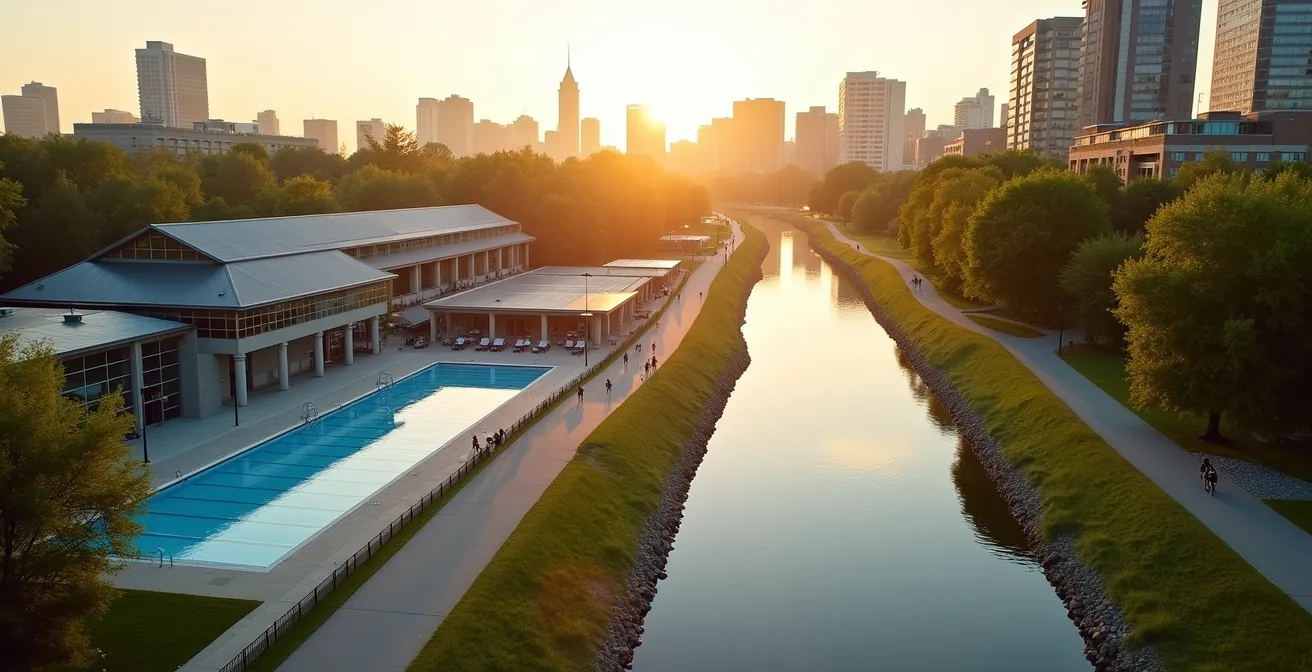
This aerial view illustrates the connected nature of Ottawa’s infrastructure. You can see how an indoor pool, a dedicated cycling pathway, and a riverside running trail can be linked to form a continuous training route. This visual represents the core of the logistical strategy: connecting the dots to build a workout that flows with the city.
Case Study: The Ottawa Triathlon Commute Strategy
A prime example of this logistical-first approach is demonstrated by athletes using city infrastructure for their training. A successful schedule could look like this: start with a morning swim at a facility like the Plant Recreation Centre. From there, instead of driving, you hop on your bike and ride east along the Trillium Pathway to your downtown office—this is your brick workout. After work, you complete the final leg with a run home, heading west along the scenic Ottawa River Pathway. This method, highlighted in programs like OC Transpo’s “Training with the Train” initiative, eliminates parking hassles and the dead time of driving between a pool, a park, and home. Your entire day becomes a structured, multi-sport training session.
By rethinking the order and leveraging the city’s design, you transform disparate workouts into a cohesive and incredibly efficient training block. You gain hours back in your week, increase your training volume, and build a more resilient athletic base.
Why the “Wolf Trail” Rating Deceives Many Occasional Hikers?
As you build your training plan, you’ll hear whispers about the legendary Wolf Trail in Gatineau Park (Trail 62). It’s often recommended as a “challenging hike,” but for a marathoner, this description is dangerously misleading. The Wolf Trail is not a casual hike; it is a specific and potent training tool for what I call “Topographical Targeting.” Understanding its true purpose is key to unlocking a new level of running strength.
The trail’s official “difficult” rating doesn’t capture the nature of its challenge. It’s not about distance; it’s about unrelenting vertical gain. The trail features several sustained, steep climbs that are the perfect natural equivalent of a track workout focused on hill repeats. For a marathoner, this is gold. Running on flat pathways builds endurance, but it’s on the hills that you build the raw power, muscular endurance, and mental fortitude needed to conquer the later stages of a race, especially on a deceptively hilly course like Ottawa’s.
A casual hiker might tackle the trail once and be exhausted. A marathoner in training, however, should approach it with a different mission. The goal isn’t just to complete the loop; it’s to perform structured repeats on its steepest sections. This targeted effort is what builds a powerful stride and a high VO2 max.
Position the Wolf Trail not as a casual hike, but as a prime location for a ‘Vertical Power Day’ essential for marathon training.
– Ottawa Marathon Training Guide, JT Running DC Ottawa Marathon Plan
This insight from an experienced coach reframes the trail’s value entirely. Don’t be deceived by the “hiker” label. View the Wolf Trail as your outdoor stadium for building leg strength. A “Vertical Power Day” here, even done with snowshoes in winter, will do more for your race-day performance than an equivalent amount of time spent on flat ground. It’s about using the right terrain for the right stimulus.
O-Train vs Bike: Which Is Faster from Westboro to Downtown?
A key component of the “Urban Cross-Training Matrix” is leveraging Ottawa’s public transit. For runners living in areas like Westboro and working downtown, the daily commute presents a strategic choice. The question isn’t just about speed; it’s about how each option fits into your overall training and recovery plan. This is where you apply the principle of logistical efficiency to every part of your day.
From a pure time perspective, the O-Train often has a slight edge for a door-to-door commute. However, a marathoner’s calculus is different. Time spent on a bike isn’t “wasted” travel time; it’s a valuable opportunity for active recovery or an additional low-impact cardio session. A 20-25 minute bike ride along the Sir John A. Macdonald Parkway is the perfect way to flush out lactic acid from a morning run or to warm up muscles before an evening workout.
The most advanced strategy, however, is the “Strategic One-Way.” This involves running one direction of your commute and taking the O-Train back. For a Westboro-to-downtown route, this opens up a massive extension to your training range. You can run a 10-15km route to work, refuel and recover at the office, and then take the train home, avoiding a grueling run back on tired legs. This tactic allows you to bank high-quality mileage without the logistical burden of a long, out-and-back route, effectively doubling your training ground.
This table, based on data from OC Transpo’s analysis, breaks down the strategic trade-offs for your commute from Westboro to downtown.
| Method | Total Time | Training Benefit | Cost |
|---|---|---|---|
| O-Train | 15 min (including walk to station) | Rest/recovery between workouts | $3.70 |
| Bike via Sir John A. Parkway | 20-25 min (including lock-up) | Active recovery, additional cardio | Free |
| Strategic One-Way Run + O-Train | Variable | Extended 25km training range | $3.70 return |
The choice is no longer just about which is fastest. It’s about deciding what your body needs on any given day. Is it a rest day where the O-Train is a recovery tool? Or is it a training day where the bike or a one-way run becomes a key part of your workout? This is how you integrate your marathon prep into the rhythm of the city.
Key Takeaways
- Embrace Ottawa’s four seasons not as obstacles, but as distinct training phases for building comprehensive physical and mental resilience.
- Integrate the city’s infrastructure—pathways, parks, and public transit—into a logistical matrix to maximize training efficiency and volume.
- Use specific terrain, like the Wolf Trail for hills and snowy paths for low-impact endurance, for targeted physiological adaptations that generic plans miss.
How to Build a Wellness Routine That Survives the Ottawa Winter?
Tying all these strategies together requires a cohesive, long-term vision. A successful marathon build in Ottawa is not a series of disconnected workouts; it’s a phased wellness routine that anticipates and leverages the city’s seasonal arc. Surviving—and thriving—through the winter comes down to having a structured plan that adapts with the changing conditions. This is the capstone of your training: the five-month Ottawa Winter Wellness Arc.
This arc isn’t just about running. It’s a holistic approach that integrates cross-training, strength work, and recovery in a way that is smart, sustainable, and specific to our city’s climate. The routine should be broken down into three distinct phases, each with a clear objective.
Case Study: The 5-Month Ottawa Winter Wellness Arc
Local programs like those offered by Run Ottawa demonstrate a best-practice phased approach that marathoners can adopt. The arc is structured as follows:
- Phase 1: Early Winter (Nov-Dec): The focus is on base building and strength. As snow begins to fall, shift some long runs to snowshoeing sessions in Gatineau Park. This builds a powerful aerobic base and strengthens stabilizer muscles with low impact, preparing your legs for the high mileage to come.
- Phase 2: Deep Winter (Jan-Feb): This is the time for intensity and resilience. When temperatures plummet below -20°C, it’s smart to move some key workouts indoors. This is the perfect time for targeted cross-training, like a session at a climbing gym like Altitude Gym for grip and core strength, or focused treadmill intervals. Outdoor runs become shorter, focused on maintaining cold adaptation.
- Phase 3: Late Winter (March-April): The transition begins. As pathways start to clear, reintroduce tempo runs and longer distances on pavement. Be mindful of the black ice protocol. This phase is about translating the raw strength built in winter back into running-specific speed and endurance.
By following this phased approach, you’re not just randomly exercising; you’re periodizing your training in harmony with the Ottawa environment. You build a deep well of fitness in the early and deep winter, then sharpen it to a fine point as spring arrives. This ensures you arrive at the marathon start line not just physically prepared, but mentally tough, confident, and perfectly adapted to the demands of the course.
Winter running can be tough to enjoy at first, but training through colder months sets you up for your best race yet.
– Run Ottawa Training Team, Bust Your Winter Training Excuses Guide
Now that you have the complete playbook, the next step is to translate this strategy into your own personalized training calendar. Start by mapping out your own five-month arc, identifying the key city resources you’ll use for each phase.