
Seeing Rideau Falls from a kayak is more than just a rental; it’s about mastering Ottawa’s unique waterways with skill and confidence.
- Success depends on strategic navigation, understanding the difference between the river and the canal, and choosing the right craft.
- Safety is paramount, involving specific knowledge of local currents and respecting official guidelines for both summer paddling and winter skating.
Recommendation: Treat your outing like a planned expedition. Assess conditions, know your route (including portage options), and you’ll transform a simple paddle into an unforgettable urban adventure.
So, you want to see the magnificent Rideau Falls from the water? Great call. Gliding across the Ottawa River, feeling the spray, and looking up at the twin curtains of water is an iconic Ottawa experience. Many guides will point you to the nearest rental shack and wish you luck. But that only scratches the surface. To truly experience the capital’s waterways, you need to think like a seasoned paddler, not just a tourist. It’s not just about renting a kayak; it’s about understanding the living, breathing system of rivers and canals that define this city.
Most people just focus on the destination, but the real magic lies in the journey—understanding the history under your hull, knowing how to navigate the engineering marvel of the locks, and making the smart choice between a kayak and a paddleboard based on the day’s conditions. This guide isn’t just about getting you to the falls. It’s about empowering you with an instructor’s mindset. We’ll cover the crucial skills, safety awareness, and insider knowledge that transform a simple paddle into a confident and deeply rewarding exploration. We’ll even connect the dots between a summer paddle on the canal and a winter skate on its frozen surface, giving you a complete, four-season mastery of this incredible urban environment.
This comprehensive guide will walk you through everything you need to know. We’ll start with the river’s historic roots and move through practical skills for navigating the locks, choosing your vessel, and identifying key safety spots. From there, we’ll cover how to get the best views and even transition your knowledge from summer paddling to winter skating on the world-famous Rideau Canal Skateway.
Summary: How to Truly See Rideau Falls: An Insider’s Guide to Kayaking Ottawa’s Waterways
- Why the Ottawa River Was Once the Most Important Highway in Canada?
- How to Pass Through the Ottawa Locks by Boat Without Stress?
- Paddleboarding vs Kayaking: Which Is Better for the Canal Currents?
- The Swimming Risk Near Prince of Wales Bridge You Must Ignore
- What Time Does the Last Water Taxi Leave for the Best Sunset View?
- Downtown vs Dow’s Lake: Which Entry Point Has Better Ice?
- How to Board the Lady Dive Amphibus Without Getting Wet?
- How to Plan Your Skate on the Rideau Canal When the Ice Condition Is Green?
Why the Ottawa River Was Once the Most Important Highway in Canada?
Before you dip your paddle into the water, take a moment. The river beneath you isn’t just a scenic route; it’s a foundational corridor of Canadian history. For centuries, it was the lifeblood of this region. As The Canadian Encyclopedia highlights, the Ottawa River has a rich heritage as the traditional territory of the Algonquin people, a vital artery for the fur trade, and the epicentre of a massive 19th-century timber boom. Every paddle stroke you take follows the path of Indigenous traders, voyageurs, and lumber barons who shaped the nation.
The river’s economic importance exploded in the early 1800s. In 1806, an entrepreneur named Philemon Wright executed a daring plan to float a raft of timber all the way down the river to Quebec City for export. His success came at a pivotal moment when Napoleon’s blockade cut off Britain’s access to Baltic wood, effectively launching the Canadian timber trade. The Ottawa Valley became a powerhouse, and this river was its main highway. This boom shaped the very landscape and economy of the city you see today, with fortunes made from the “square gold” that travelled this exact waterway.
This history is still visible in the grand architecture along the shoreline and in the very design of the city. Understanding this legacy adds a profound layer to your journey. You’re not just kayaking; you’re paddling through time on a route that built a capital. It gives you a deeper appreciation for the scale and importance of the waterway you’re about to explore.
How to Pass Through the Ottawa Locks by Boat Without Stress?
Alright, let’s talk mechanics. One of the most impressive features connecting the Ottawa River to the Rideau Canal is the Ottawa Locks, a stunning flight of eight locks lifting boats 24 metres (79 feet) from the river up to Parliament Hill. While it’s an amazing sight, navigating them in a small vessel like a kayak requires specific knowledge. The key to a stress-free passage is preparation. First, you must purchase a valid lockage permit from Parks Canada before you even approach. You can’t just show up and expect to get through. Once you have your permit, signal your intent to the lockmaster and wait for the green light, which indicates it’s safe to enter the lock chamber.
Once inside, the process is straightforward but requires your full attention. You’ll be given cables along the lock wall to hold onto. Your job is to hold steady while the water level rises or falls around you—don’t tie your boat off! Just maintain a firm grip. However, there’s an expert alternative that many seasoned paddlers prefer: portaging. This means carrying your kayak or canoe along the designated paths next to the locks. It’s often faster, gives you a fantastic on-foot view of the lock system, and avoids the waiting time and potential congestion with larger boats inside the chamber. It’s a key skill in waterway mastery.
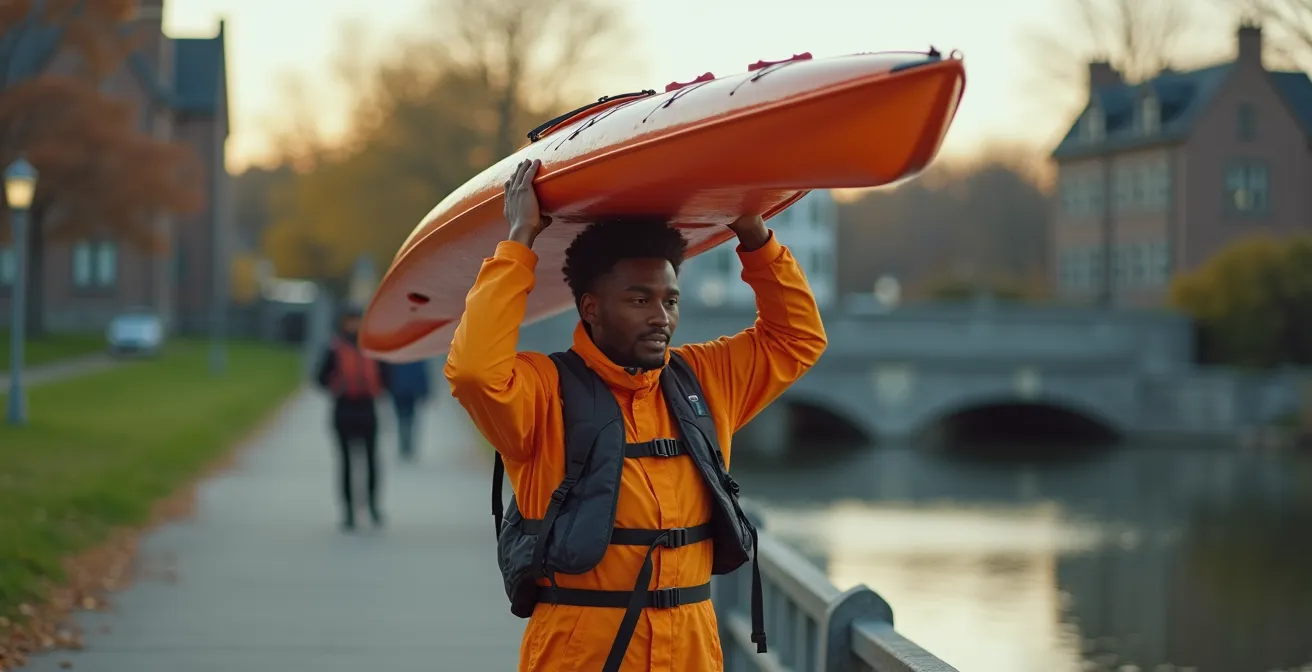
As the image shows, the portage route is a scenic walk in itself, turning a potential logistical hurdle into an enjoyable part of your journey. Whether you choose to lock through or portage, the decision is a strategic one. Locking through is a unique experience, while portaging is efficient and offers a different perspective. Knowing you have both options is what separates a novice from a prepared paddler.
Paddleboarding vs Kayaking: Which Is Better for the Canal Currents?
Now that you know how to get between the river and the canal, let’s talk about the right tool for the job. The choice between a stand-up paddleboard (SUP) and a kayak depends entirely on your planned route and the day’s conditions. The Ottawa River can be windy and choppy, while the Rideau Canal is generally calm and sheltered. This difference is critical. A kayak, with its low profile and seated position, offers superior stability and less wind resistance, making it the clear winner for the open and potentially wavy Ottawa River.
The Rideau Canal, on the other hand, is a different beast. It is a “slack water” system, meaning it has very little natural current. In fact, Parks Canada confirms that only 19 kilometres of its 202-kilometre length are man-made channels; the rest is composed of placid lakes and flooded river sections. This makes the canal an ideal environment for a SUP. Standing on a paddleboard gives you a fantastic vantage point for sightseeing and a more relaxed, full-body workout. However, a kayak will still be more efficient for covering longer distances on the canal, like the trip to Dow’s Lake.
To make the choice clearer, here is a direct comparison for Ottawa’s specific waterways.
| Factor | Kayaking | Paddleboarding (SUP) |
|---|---|---|
| Ottawa River Stability | Superior in choppy conditions and wind | Challenging in wind and waves |
| Rideau Canal Performance | Good for longer distances | Ideal for calm water and better views |
| Wind Resistance | Lower profile reduces wind impact | Higher profile catches more wind |
| Dow’s Lake Experience | Efficient for covering distance | Better for leisurely exploration |
| Lock Passage Allowed | Yes with permit | No – portage required |
Ultimately, the choice is yours, but now it’s an informed one. For a trip focused on the Rideau Falls on the river, a kayak is your most reliable option. For a leisurely cruise down the calm canal, a paddleboard is an excellent choice. And remember, only kayaks are permitted to go through the locks; SUPs must be portaged.
The Swimming Risk Near Prince of Wales Bridge You Must Ignore
Safety first, always. While the Ottawa River looks inviting on a hot day, you must be extremely cautious about where you choose to cool off. A particularly dangerous and often tempting spot is near the Prince of Wales Bridge and the Deschênes Rapids. The area is known for its beauty but also for its treacherous underwater currents. It is absolutely not a safe place for swimming. Even strong swimmers can be quickly overwhelmed.
This isn’t just friendly advice; it’s a critical safety warning from local experts. As the team at Frontenac Outfitters, a respected local paddling authority, explicitly warns in their safety guide: you need to “Watch out for the very strong currents around the falls.” This applies to both paddlers and especially anyone thinking of swimming. The river’s power is concentrated in these areas and is dangerously deceptive from the surface. A responsible paddler knows to respect these invisible forces.
The good news is that Ottawa has fantastic, designated swimming beaches that are monitored for safety and water quality. There is no reason to take a risk. If you want to swim, make the smart choice and head to one of these locations:
- Britannia Beach: A large, popular beach with lifeguards and excellent facilities.
- Westboro Beach: Offers a designated swimming area with a shallow entry, perfect for families.
- Mooney’s Bay Beach: Another family-friendly spot with volleyball courts and picnic areas.
- Petrie Island Beaches: A series of beautiful sandy beaches offering plenty of space to relax and swim safely.
Being a master of the waterway means knowing its dangers as well as its pleasures. Admire the power of the river from the safety of your kayak, and save the swimming for the designated spots where you can relax and enjoy the water without risk.
What Time Does the Last Water Taxi Leave for the Best Sunset View?
After a day of paddling, there’s no better reward than watching the sun set over the Ottawa skyline from the water. The golden hour light painting Parliament Hill is a truly breathtaking sight. While water taxis offer one way to see it, the ultimate front-row seat is from your own kayak. The key is timing. You want to be on the water as the sun begins to dip, casting long shadows and igniting the sky.
Local tour operators have perfected this experience, and we can learn from their strategy. For example, a case study of Escape Tours’ sunset kayak experience shows that their tours from the NCC River House are specifically timed to catch the best light. They typically depart about two hours before sunset during peak season. This gives paddlers enough time to comfortably reach a prime viewing location in front of Parliament and the Rideau Falls, settle in, and enjoy the entire spectacle from golden hour through to the final moments of twilight. This is the expert approach: planning your launch time based on the sunset, not just paddling out and hoping for the best.
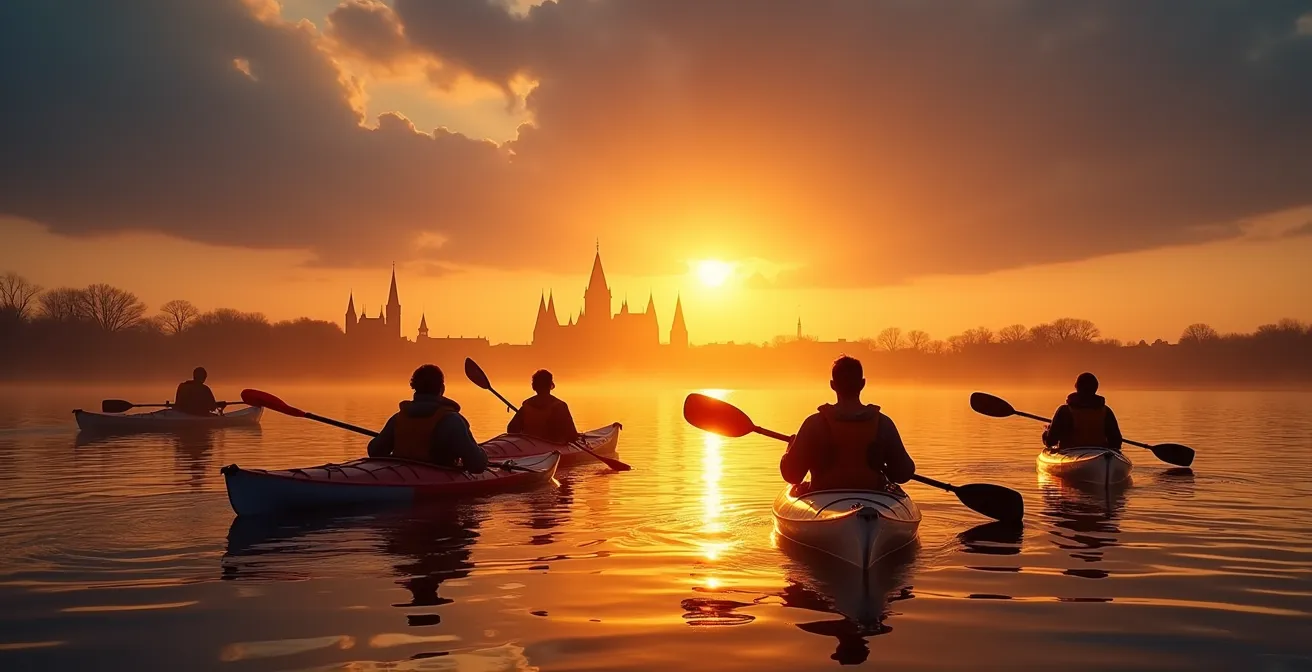
The view is your reward for a day of smart and safe paddling. Being out on the calm river, with the silhouette of the Peace Tower against a fiery sky, is an unforgettable moment that connects you to the heart of the city. Forget crowded lookout points on land; this is the most serene and spectacular way to end a day in Ottawa. Just remember to have the proper lights for your vessel if you plan to be on the water after dusk, as required by safety regulations.
Downtown vs Dow’s Lake: Which Entry Point Has Better Ice?
As the seasons turn, waterway mastery in Ottawa takes on a new form. The same Rideau Canal that you paddle in the summer transforms into the world’s largest skating rink. But just as in paddling, a great experience on the Rideau Canal Skateway depends on making smart, strategic choices. A key decision is where to start your skate: from the downtown entry points near the National Arts Centre (NAC) or further south at Dow’s Lake?
The answer often comes down to ice quality. Dow’s Lake is a wide, shallow basin, which means it freezes faster and more consistently than the deeper, narrower channel downtown. This often results in better and more reliable ice conditions, especially at the beginning and end of the season. This is particularly relevant as skating seasons can be unpredictable; for instance, recent records show that 2024 marked the shortest skating season with only 10 days of skating, making every good ice day precious. Beyond the ice, each entry point offers a different experience.
Here’s how the two main access areas stack up, helping you choose the right starting point for your perfect skate day.
| Factor | Downtown Entry (NAC) | Dow’s Lake Entry |
|---|---|---|
| Ice Quality | Deeper water, slower freeze | Shallow basin, faster/better freeze |
| Parking | Limited street parking | Large paid lots available |
| Transit Access | Multiple OC Transpo stops | Limited bus service |
| Amenities | Urban restaurants nearby | BeaverTails, warming huts |
| Best For | Tourists wanting iconic views | Families with children |
For those seeking the best possible ice and classic rink-side amenities like a hot BeaverTail pastry, Dow’s Lake is typically the superior choice. If you prioritize iconic views of Parliament and easy access by public transit for a shorter skate, the downtown entry points are ideal. The expert move is to check the NCC’s official ice condition map online before you go, and choose your entry point based on that day’s reality.
How to Board the Lady Dive Amphibus Without Getting Wet?
For a completely different perspective on Ottawa’s waterways, you can’t beat the Lady Dive Amphibus. This unique vehicle takes you on a tour of the city streets before plunging directly into the Ottawa River for a cruise. While it’s a fun and quirky experience, the “splashdown” moment can leave some passengers a bit wetter than they planned. But with a little insider knowledge, you can stay dry and still get great views.
The secret is strategic seating. The biggest splash happens at the front of the bus when it enters the water at the Jacques-Cartier Park ramp. Therefore, the first rule of staying dry is to avoid the first three rows. The seats in the middle of the bus, roughly rows four through six, typically experience the least amount of splash. Furthermore, for the best view of the Rideau Falls from the water portion of the tour, try to sit on the right side of the bus (starboard side when on the water). This side generally faces the falls during the cruise.
Here are a few pro-tips for boarding the Amphibus prepared:
- Choose rows 4-6 for the driest ride.
- Sit on the right side for superior views of Rideau Falls.
- Wear quick-dry clothing and avoid sensitive materials like suede.
- Protect your electronics in a waterproof bag, regardless of where you sit. It’s always better to be safe than sorry!
Following these simple tips ensures you can enjoy the novelty of the Amphibus without an unexpected shower. It’s another example of how a little bit of local knowledge can significantly enhance your experience of Ottawa’s attractions, whether you’re powering the vessel yourself or letting a bus-boat do the work.
Key takeaways
- Waterway Mastery: True enjoyment comes from understanding the environment—from its history to its currents and seasonal changes.
- Strategic Choices Matter: Your experience is shaped by decisions you make before you start, like choosing between a kayak or SUP, and a downtown or Dow’s Lake entry point.
- Safety Is Proactive: Expert navigation isn’t just about skill; it’s about knowing the risks (like currents near bridges) and choosing safe alternatives.
How to Plan Your Skate on the Rideau Canal When the Ice Condition Is Green?
Seeing the “Green Flag” on the NCC’s ice report for the Rideau Canal Skateway is the moment every Ottawa resident and visitor waits for all winter. It means go-time! But a green flag doesn’t mean you should just show up and start skating. To truly master a skate day, you need a plan. The quality of the ice can change dramatically throughout the day, and a little strategy will elevate your experience from good to perfect.
First, timing is everything. For the best ice, go early. The hardest and fastest ice conditions are almost always found before 10 AM, before the sun softens the surface and the crowds arrive. This is when you can truly glide. Also, “green” is a general status. Always check the detailed segment reports online. A section might be rated “Fair” while the rest is “Good,” allowing you to plan a route that avoids the rougher patches. This level of detail is the hallmark of an expert’s approach.
Thinking about your skate as a one-way journey instead of an out-and-back trip can also be a game-changer. A great strategy is to start at Dow’s Lake, skate the full 7.8 km downtown with the wind (hopefully) at your back, and then take an OC Transpo bus back. This lets you see the entire length of the skateway without facing a tiring return trip against the wind. With a plan, you’re not just skating; you’re executing a perfect winter expedition.
Your Green Flag Day Action Plan: Optimizing Your Skate
- Morning skate: Aim for the hardest and fastest ice conditions before 10 AM.
- Check segment reports: A “Green” overall status can hide “Fair” sections; plan your route to avoid them.
- Employ a one-way strategy: Start at Dow’s Lake, skate to downtown, and take a bus back to maximize enjoyment.
- Pack essential gear: Sunglasses for sun glare off the ice, a windproof layer, and a thermos with a hot beverage are non-negotiable.
- Consider late afternoon: While the ice may be softer, this time offers the best light for stunning sunset photography over the frozen canal.
By applying this mindset of preparation and strategic thinking, you move beyond being a simple participant and become a true navigator of Ottawa’s incredible waterways. Whether it’s the liquid blue of summer or the solid white of winter, your adventure will be safer, smarter, and infinitely more rewarding. Plan your route, respect the conditions, and earn that incredible view.