
The most compelling photographs of Ottawa’s Parliament are created by treating the sun as an artistic collaborator, not just a light source.
- Master key moments like the morning sun turning copper roofs to gold and the dramatic sunset silhouettes seen from the Gatineau shoreline.
- Reframe the massive ongoing construction not as an obstacle, but as a unique compositional element that adds a layer of temporal history to your images.
Recommendation: Instead of randomly visiting viewpoints, follow a deliberate “light-chasing itinerary” to capture the architecture’s evolving personality from dawn until dusk.
As an architectural photographer in Ottawa, I’ve learned that capturing Parliament Hill is less about finding a single postcard angle and more about engaging in a dialogue with light. Amateur photographers and enthusiasts often arrive with a checklist of locations, hoping to replicate a famous shot. They hunt for the perfect, unobstructed view, treating the sun as a simple on/off switch for “good lighting.” This approach, however, misses the soul of the architecture—the way Nepean sandstone absorbs the morning warmth or how the Gothic Revival spires cut through the soft, ambient light of the blue hour.
The real secret lies in understanding the materials, the angles, and the passage of time. It’s about seeing the building not as a static monument, but as a dynamic canvas that changes its mood with every degree the sun travels across the sky. The current, massive renovation project, which many see as a photographic impediment, is actually a gift. The cranes, scaffolding, and printed tarps offer a transient narrative layer, a chance to create images that are unique to this specific moment in Canadian history—a visual story of preservation and transformation.
This guide abandons the static checklist. Instead, we will embark on a photographic journey that follows the sun. We’ll explore how to capture the symbolic details of the Peace Tower, how to use the Ottawa River for reflections without battling glare, and how to choose the right viewpoint for the story you want to tell. We will turn the construction into a creative advantage and build an itinerary that ensures you are always in the right place at the right time. Prepare to see Parliament Hill not just as a landmark, but as a living subject waiting to be photographed.
This article provides a complete framework for photographing Parliament Hill like a professional. It’s structured to guide you from understanding detailed symbolism to mastering technical challenges and planning your day around the perfect light.
Summary: The Definitive Photographer’s Itinerary for Parliament Hill
- Why the Peace Tower’s Design Symbolizes More Than Just Governance?
- How to Photograph the Parliament Library Without Glare from the River?
- Major’s Hill Park or Nepean Point: Which View of Parliament Wins?
- The Construction Reality: What Is Visible of Center Block This Year?
- In What Order Should You Visit the Landmarks to Follow the Sun?
- When to Visit the Greenbelt to Catch the Fall Colors at Their Peak?
- What Settings Capture the Parliament Light Show Without Blur?
- Why Do Ottawa’s Red Brick Homes Command Such High Market Value?
Why the Peace Tower’s Design Symbolizes More Than Just Governance?
The Peace Tower is more than the geographic and political heart of Ottawa; it’s a deeply layered memorial rendered in stone. To photograph it effectively, you must look past its grand silhouette and focus on its intricate narrative. The tower was rebuilt after the Great Fire of 1916 and rededicated to Canada’s commitment to peace. Its design is a masterclass in architectural symbolism, with carvings of grotesques, gargoyles, and Canadian flora and fauna telling stories of the nation’s history and wartime sacrifice. During golden hour, the low-angle light rakes across the Wallace sandstone, transforming these subtle carvings into dramatic, high-contrast details.
Your goal as a photographer is to isolate these symbolic elements. Don’t just take a wide shot of the tower; use a telephoto lens to frame the clock face against the warm sky or to capture the play of light on the bronze tracery of the observation deck windows. The true art lies in seeing the tower not as one object, but as a collection of smaller, meaningful compositions. Think of it as portrait photography; you are capturing the character and story etched into the stone, a story that resonates with the more than 3 million visitors who come to Parliament Hill annually.
Your Action Plan: Capturing the Peace Tower’s Symbolism
- Position yourself on Wellington Street 45 minutes before sunset for optimal side-lighting on the grotesques and war memorial carvings.
- Use an 85-100mm telephoto lens to isolate specific architectural details like the WWI memorial elements in the stonework.
- Frame the Peace Tower from the east during morning golden hour to capture the green copper roof’s transformation to gold.
- Schedule your shoot to coincide with a carillon recital for an added atmospheric layer to your visual story.
- Utilize the construction tarps’ printed imagery as a foreground element to create a temporal narrative layer in your composition.
How to Photograph the Parliament Library Without Glare from the River?
The Library of Parliament, with its magnificent copper dome and Gothic Revival buttresses, is one of the most photogenic structures on the Hill. However, its proximity to the Ottawa River presents a classic challenge: glare. Many photographers attempt to capture its reflection during the day, only to be frustrated by harsh sunlight bouncing off the water’s surface, washing out the details. The solution is not to fight the light, but to wait for it to change. The most magical window for this shot is not golden hour, but the “blue hour”—the 20-30 minute period just after sunset or before sunrise when the sun is below the horizon.
During blue hour, the sky is filled with a deep, ambient blue light. This cool, diffused illumination eliminates harsh shadows and glare, transforming the river into a perfect, dark mirror. As the exterior architectural lights turn on, they “paint” the library with a warm, amber glow. This creates a stunning colour contrast between the cool blue of the sky and water and the warm gold of the illuminated building. From the Gatineau shoreline, you can achieve a perfectly symmetrical composition, capturing the library and its flawless reflection in the still water.

This technique is about patience and timing. As professional photographers note, early morning shots from Wellington Street cast warm light, but for reflections, the post-sunset window is unparalleled. You trade the drama of golden hour for the serene, painterly quality of twilight, resulting in an image that feels both majestic and deeply tranquil.
Major’s Hill Park or Nepean Point: Which View of Parliament Wins?
Two of the most celebrated viewpoints of Parliament Hill are Major’s Hill Park and the recently re-imagined Nepean Point. Choosing between them isn’t about which is “better,” but about which best suits your photographic intention. Major’s Hill Park excels at narrative composition. From here, you can frame the Parliament buildings between the modern glass architecture of the National Gallery of Canada and the fairy-tale turrets of the Château Laurier. This creates a visual story of Ottawa’s architectural evolution. It’s the ideal spot for a sunrise shoot, as the morning light catches the east-facing facades.
Nepean Point, on the other hand, is all about majestic scale. Its elevated position offers a powerful, unobstructed panoramic view of the entire parliamentary complex, the river, and the city skyline. This is the place for your wide-angle lens, especially at sunset, when you can capture the grandeur of the entire scene silhouetted against the colourful sky. While Major’s Hill Park offers context and storytelling, Nepean Point provides a sense of epic scale and sovereign beauty.
As Ottawa Tourism highlights, even indoor locations can offer stunning perspectives. The Scotiabank Great Hall within the National Gallery provides a unique, weather-proof vantage point that leverages the park and Hill as a backdrop. They note:
Just beyond the main entrance of the glass-and-granite National Gallery of Canada, the Colonnade and the Scotiabank Great Hall give you some of the city’s best views of the ByWard Market, Major’s Hill Park, Parliament Hill and the Ottawa River—especially at sunset.
– Ottawa Tourism, Indoor spots to photograph in Ottawa
To make the best decision for your shoot, a direct comparison is essential. This table breaks down the key advantages and challenges of each primary viewpoint.
| Viewpoint | Best For | Optimal Time | Key Advantages | Challenges |
|---|---|---|---|---|
| Major’s Hill Park | Narrative Composition | Sunrise (6:30-7:30 AM) | Frames Parliament between National Gallery glass and Château Laurier castle-like architecture | Can be crowded during tourist season |
| Nepean Point | Majestic Scale | Sunset (6:00-7:00 PM) | Elevated unobstructed view capturing entire complex with river, ideal for wide-angle | Potential construction access issues, check NCC quarterly updates |
| Terrasse de la Chaudière (Gatineau) | Silhouette Photography | Sunset (6:30-7:30 PM) | Sun sets directly behind buildings creating perfect silhouettes of skyline | Requires crossing to Quebec side |
The Construction Reality: What Is Visible of Center Block This Year?
The elephant on the Hill is the massive, multi-decade renovation of Centre Block. Far from being a photographic deal-breaker, this period of transformation offers a unique opportunity for temporal composition. The core of the building is currently shrouded in scaffolding and decorative tarps, an extensive project expected to continue past 2028. Rather than trying to shoot around the construction, the creative photographer embraces it.
Public Services and Procurement Canada has brilliantly installed decorative tarps printed with a realistic, life-size image of the Centre Block’s facade. This “trompe-l’œil” (trick of the eye) creates a surreal, fascinating subject. You can photograph the perfect, printed image of the building with real construction cranes looming over it, creating a powerful story about heritage and renewal. This is a scene that will be gone in a few years, making your photographs a valuable historical document of this specific era.
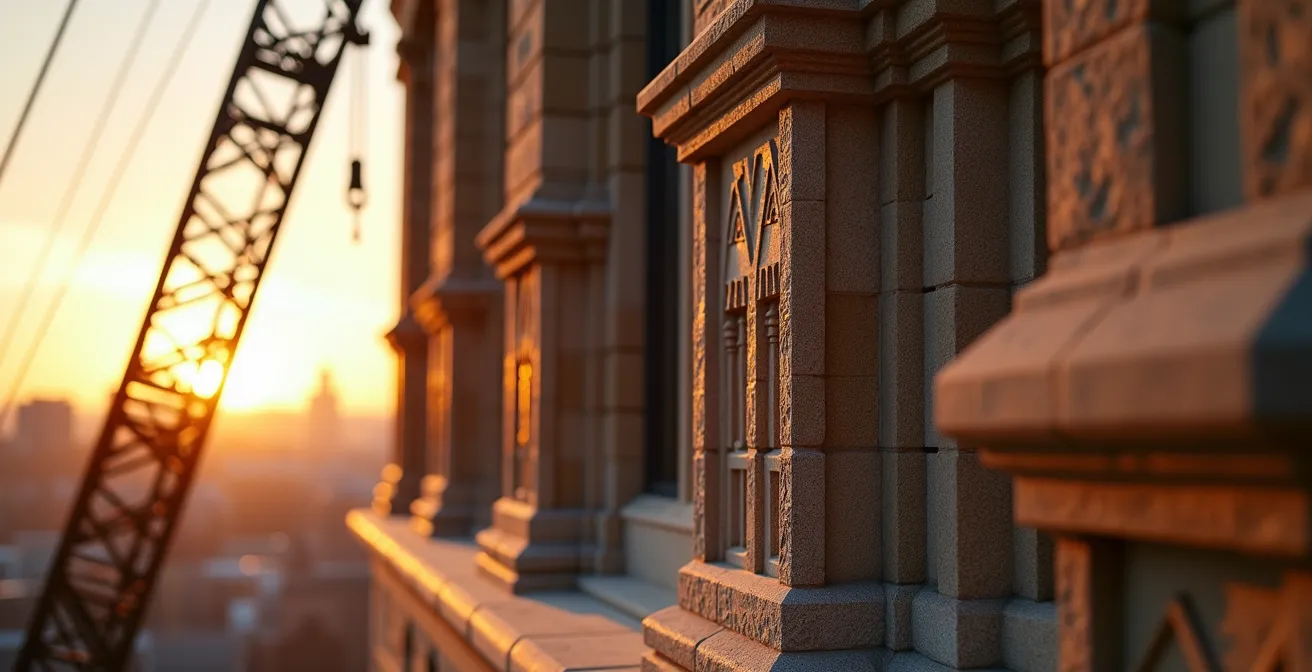
Furthermore, the work on Centre Block means the beautifully restored East and West Blocks are now the primary architectural subjects. Focus your lens on the intricate Victorian High Gothic masonry of the East Block, using the geometric arms of the cranes as framing devices. During golden hour, the low sun on the sandstone reveals incredible texture and detail. A macro lens can capture the precision of 19th-century craftsmanship in a way that feels immediate and tactile, with the blurred shapes of modern machinery in the background providing a compelling contrast. This entire undertaking is part of an extensive renovation project underway since 2002, making this a long-term photographic theme.
In What Order Should You Visit the Landmarks to Follow the Sun?
To truly capture Parliament Hill’s architectural drama, you must think like a film director and choreograph your movements to match the sun’s path. A “light-chasing itinerary” ensures you are always positioned to capture the most dynamic light on each facade. The day begins facing east to catch the first light and ends facing west to capture the final moments of sunset. This is not a casual stroll; it is a strategic plan to maximize your photographic opportunities from dawn until dusk.
The journey starts before sunrise at the National Gallery, using its glass facade to capture abstract reflections of the waking sky. As the sun rises, you move to Major’s Hill Park for the classic, warm side-lighting on Parliament. The key is to keep moving, anticipating how the light will interact with the next location. In the evening, the sequence is reversed. You start with front-lit shots on Wellington Street and then cross the bridge to Gatineau, positioning yourself for the grand finale: a perfect silhouette of the parliamentary skyline as the sun dips directly behind it. This methodical approach transforms a day of shooting into a deliberate artistic practice.
Here is a proven itinerary for a full day of architectural photography:
- Start at 6:00 AM: National Gallery of Canada’s glass facade catching first eastern light reflections.
- 6:45 AM: Move to Major’s Hill Park for elevated sunrise shots of Parliament Hill with warm side-lighting.
- 7:30 AM: Capture the Rideau Canal locks before taller buildings cast shadows over the lower structures.
- 5:30 PM: Position at Wellington Street for the front-lit West Block during the afternoon golden hour.
- 6:15 PM: Relocate to the Supreme Court of Canada for dramatic western facade illumination.
- 6:45 PM: End at Terrasse de la Chaudière in Gatineau for silhouette shots as the sun sets behind Parliament.
When to Visit the Greenbelt to Catch the Fall Colors at Their Peak?
For the photographer seeking to connect Ottawa’s urban architecture with its natural landscape, the National Capital Greenbelt in autumn is an essential detour. This protected expanse of wilderness offers a stunning contrast to the stone and copper of Parliament Hill. The peak of fall colour in Ottawa typically occurs from late September to mid-October, but the exact timing varies each year based on temperature and rainfall. The key is to watch local foliage reports and be ready to go when the maples turn their brilliant shades of red, orange, and gold.
The most magical time to photograph the Greenbelt is during the evening golden hour. Find a location like the trails near Shirleys Bay, where you can position yourself with the setting sun behind the trees. This strong backlighting makes the maple leaves glow as if they were made of stained glass. Their translucency is revealed, and the light filtering through them creates a warm, ethereal atmosphere. Use a wider lens (28mm is ideal) and a smaller aperture (like f/11) to keep both the foreground leaves and the distant trees in focus.
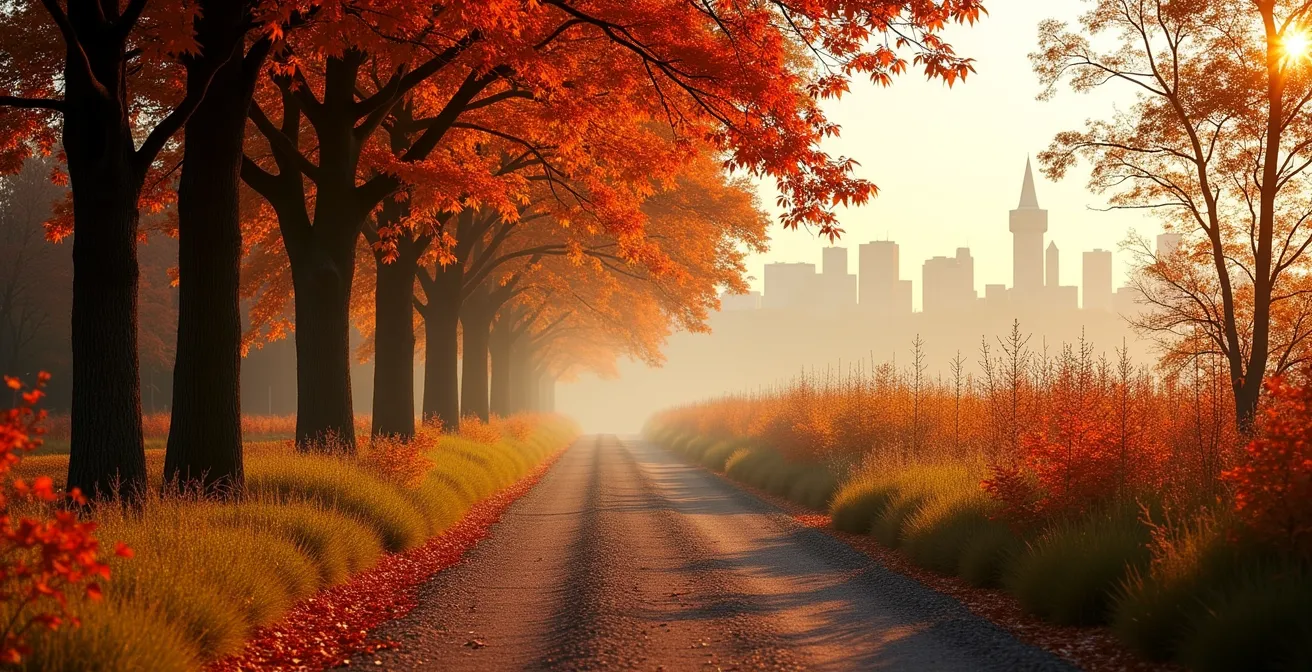
From certain vantage points in the Greenbelt’s western sections, you can even compose your shot to include the distant silhouette of the Ottawa skyline. The Peace Tower, barely visible through the hazy, golden autumn air, provides a subtle but powerful link between the wildness of the landscape and the seat of the nation. This isn’t just a nature shot; it’s a uniquely Canadian landscape photograph that tells a story of balance between nature and city.
What Settings Capture the Parliament Light Show Without Blur?
After the sun has set and the blue hour has faded, Parliament Hill offers one last spectacle: the Sound and Light Show. This nightly event in the summer projects a vibrant, animated story onto the facade of Centre Block. Photographing it presents a unique set of challenges. You are dealing with low light, moving projections, and the need for absolute stability. The enemy here is blur, caused by either camera shake or incorrect shutter speeds. Success is entirely dependent on having the right gear and the right settings.
First and foremost, a sturdy tripod is non-negotiable. Hand-holding is not an option. To eliminate even the slightest shake from pressing the shutter button, use a 2-second timer or a remote shutter release. Your goal is to find the sweet spot for your shutter speed—fast enough to freeze some of the animation’s detail, but slow enough to let in sufficient light. A speed between 1 and 2 seconds is often a great starting point. Pair this with a wide aperture (f/2.8-f/4) to gather as much light as possible. Start your ISO at 400 and only increase it if absolutely necessary to avoid introducing digital noise.
One of the most critical steps is to set your focus manually before the show begins. Use your camera’s live view, digitally zoom in on a brightly lit detail like a window frame on the “trompe-l’œil” tarp, and perfect your focus. Once it’s locked in, don’t touch it. This ensures every shot you take will be consistently sharp. For this type of work, a wide-angle lens in the 16-35mm range is ideal, as it allows you to capture the full breadth and height of the spectacle.
Your checklist for a sharp light show photo is as follows:
- Mount the camera on a sturdy tripod and use a 2-second timer or cable release.
- Start with a wide aperture like f/2.8 or f/4 to maximize light.
- Set your shutter speed to 1-2 seconds to capture light movement without excessive blur.
- Begin with an ISO of 400 and adjust upward only if needed, staying below ISO 1600.
- Switch to manual focus and lock it on a lit Parliament window before the show starts.
Key Takeaways
- True architectural photography is a dialogue with light; follow the sun’s path to capture the building’s changing character.
- Embrace imperfections like construction as unique, temporary elements that add historical narrative to your compositions.
- Mastering different light qualities—from the raking light of golden hour to the diffused light of blue hour—is essential for varied and professional results.
Why Do Ottawa’s Red Brick Homes Command Such High Market Value?
The architectural enthusiast’s journey through Ottawa doesn’t end on Parliament Hill. To truly understand the city’s character, one must wander into historic neighbourhoods like The Glebe. Here, you’ll find a different kind of Canadian architectural heritage, expressed not in grand sandstone but in warm, distinguished red brick. These century-old homes command such a high market value because they embody a blend of historic craftsmanship and modern desirability that is increasingly rare.
Many of these homes, which typically sell for between $1.1M and over $2.5M, feature original brickwork, stained glass windows, and ornate woodwork that reflect the artistry of early Ottawa builders. This is the same principle of enduring quality seen in the Parliament Buildings, but on a human scale. Buyers are not just purchasing a house; they are investing in a piece of the city’s tangible history. This demand for character, combined with limited housing inventory in a highly walkable, mature neighbourhood, creates a market where property values have shown strong and reliable appreciation.
For a photographer, these homes offer a study in texture, pattern, and colour. The “dialogue with light” continues here. The morning sun can make the red brick glow with warmth, while the shadows cast by mature trees create intricate patterns on the facades. Capturing these homes is an exercise in appreciating the details that give a city its soul, proving that architectural beauty in Ottawa is found in both its monumental icons and its charming residential streets.
With this guide, you are no longer just a visitor with a camera; you are an architectural storyteller. Your lens is now a tool to interpret light, to document time, and to reveal the soul of Ottawa’s most iconic structures. The next step is to take this knowledge out into the field and begin your own visual dialogue with the city.
Frequently Asked Questions on Parliament Photography
When exactly is golden hour in Ottawa throughout the seasons?
Golden hour in Ottawa occurs in the morning for approximately one hour after sunrise and in the evening for one hour before sunset. The specific times vary significantly by season, with much earlier sunrises in summer and later ones in winter, so always check a reliable forecast app on the day of your shoot.
How does Ottawa’s latitude affect golden hour duration?
Because Ottawa is located farther from the equator, the sun rises and sets at a shallower angle. This means it takes longer to pass through the “golden hour” altitude, effectively extending the duration of this beautiful, soft light compared to locations in equatorial regions.
What’s the difference between golden hour and blue hour for architectural photography?
The blue hour occurs shortly before sunrise or after sunset when the sun is below the horizon. It creates a soft, cool, predominantly blue light with no sharp shadows, which is ideal for capturing buildings with their exterior lighting turned on. Golden hour provides warm, directional light that creates long shadows and highlights texture.