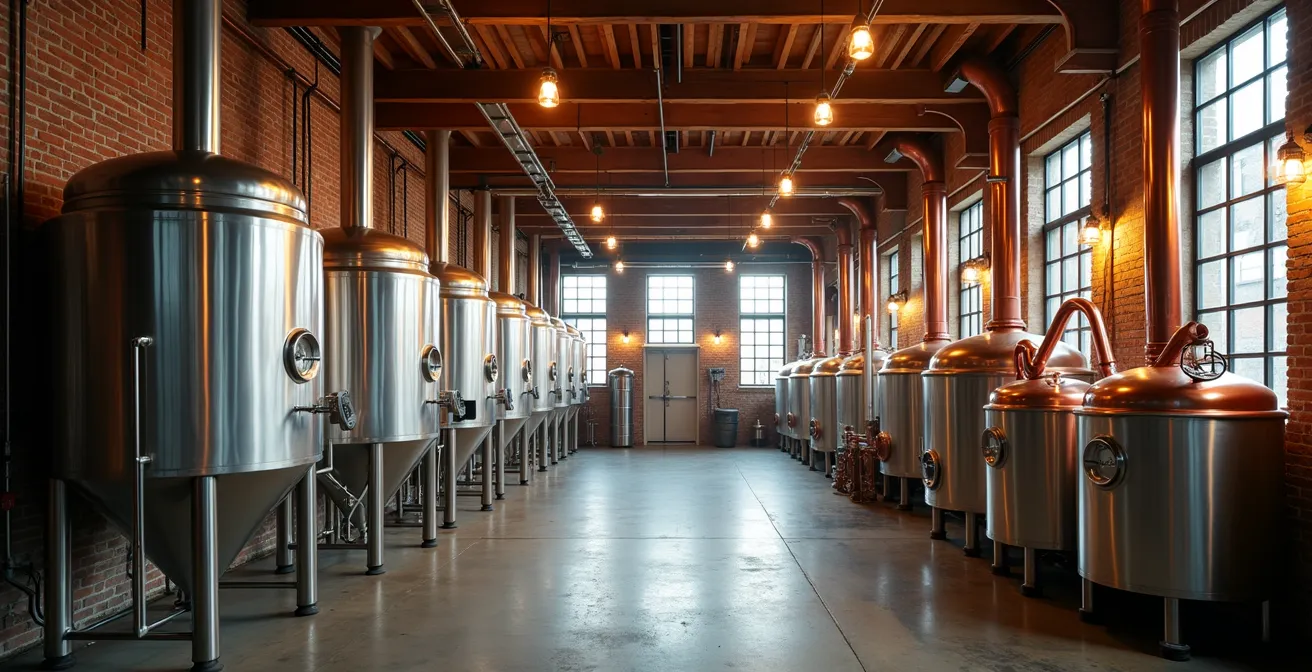
The best brewery tour isn’t about finding the ‘best’ beer, but understanding the operational choices that make each brewery unique.
- A brewery’s most interesting beers are often taproom-exclusives due to Ontario’s complex distribution and licensing laws.
- The ideal tasting order is based on intensity (IBUs, ABV), not color, to prevent palate fatigue and properly appreciate each brew.
Recommendation: Select your tour based on the ‘why’—the brewing philosophy, taproom atmosphere, and business model—not just the tap list.
For the true brewing nerd, the question of which Ottawa microbrewery offers the best tour goes far beyond a simple tasting flight. Anyone can read a tap list online. The real value of a behind-the-scenes tour lies in understanding the decisions, constraints, and passion that shape the beer in your glass. It’s about connecting with the process, the people, and the philosophy behind the fermenters. Many guides will give you a simple list of popular spots, focusing on patios and social vibes, which is fine for a casual afternoon.
However, that approach misses the core of what makes Ottawa’s craft scene so vibrant. It overlooks the technical nuances and the ‘why’ behind each brewery’s operational footprint. Why are the most exciting, experimental one-offs only available on-site? How is a taproom’s atmosphere deliberately engineered to reflect a brewing ethos? And what’s the technically correct way to approach a tasting flight to do justice to the brewer’s work?
This guide takes a different approach. We’re moving past the surface-level recommendations to give you an insider’s framework for choosing a tour. We will decode the logistical and sensory details that define a brewery’s character. By understanding the interplay of provincial regulations, food pairings, taproom design, and even transportation logistics, you can identify the experience that truly aligns with your curiosity as a brewing aficionado. This is your guide to finding not just a good beer, but a great story.
This comprehensive guide is structured to give you the technical and practical knowledge needed to select and enjoy the perfect Ottawa brewery tour. Explore the sections below to master every aspect of your craft beer journey.
Summary: A Technical Guide to Ottawa’s Brewery Tours
- Why Small Batch “One-Offs” Are Only Available at the Brewery?
- How to Pair Your Flight with the Right Food Truck on Site?
- Beyond the Pale or Tooth and Nail: Which Taproom Atmosphere Suits You?
- The Transport Mistake That Risks Your License After a Tour
- In What Order Should You Drink Your 4 Tasters?
- Hop-On Hop-Off vs Guided Trolley: Which Covers More Ground?
- How to Find a Quiet Coworking Spot in the Business District?
- Is the Haunted Walk of Ottawa Worth the Ticket Price for Locals?
Why Small Batch “One-Offs” Are Only Available at the Brewery?
The frustration of discovering a phenomenal, small-batch beer at a brewery taproom, only to find it’s unavailable at the LCBO or The Beer Store, is a common experience for any craft beer enthusiast. This isn’t an arbitrary decision; it’s a direct result of a brewery’s operational footprint, shaped by complex provincial regulations. For a small producer, getting a product onto retail shelves is a significant logistical and financial undertaking. While recent Ontario regulations mandate a 20% minimum shelf space requirement for craft producers in many stores, navigating the system for a single, limited-run beer is often unfeasible.
The core of the issue lies in Ontario’s licensing. Many small breweries operate under a “Tied House” license, which primarily allows for on-site sales. To distribute more widely, they must navigate a system of third-party distributors that was largely closed to new entrants after 2021. According to the Alcohol and Gaming Commission of Ontario (AGCO), breweries holding a Brewery Licence face specific limitations on who they can distribute to. This framework creates a powerful incentive for breweries to focus on direct-to-consumer sales for their most creative and experimental products.
This system, while complex, creates a unique opportunity for the dedicated tour-goer. The taproom transforms from a simple bar into an exclusive hub for innovation. That hazy IPA with experimental hops or that barrel-aged sour you can’t find anywhere else exists because its entire, limited production run can be sold directly to passionate consumers like you. A behind-the-scenes tour, therefore, often includes access to the freshest, most interesting beer a brewery produces, straight from the source—a privilege that retail logistics simply cannot match. It’s the ultimate reward for making the trip.
How to Pair Your Flight with the Right Food Truck on Site?
A brewery’s partnership with a food truck has evolved far beyond a simple convenience. At its best, it’s a curated culinary experience—a symbiotic pairing where the food and beer are designed to elevate one another. A generic hot dog stand won’t do; the best breweries in Ottawa seek out food partners whose offerings complement their specific beer styles. This creates a powerful draw, turning a brewery patio into a full-fledged dining destination and answering the perennial question of where to find the best brewery patio experience.
This paragraph introduces the concept of a brewery’s partnership with a food truck. To well understand it, it is useful to visualize its components in action. The illustration below captures this vibrant scene.
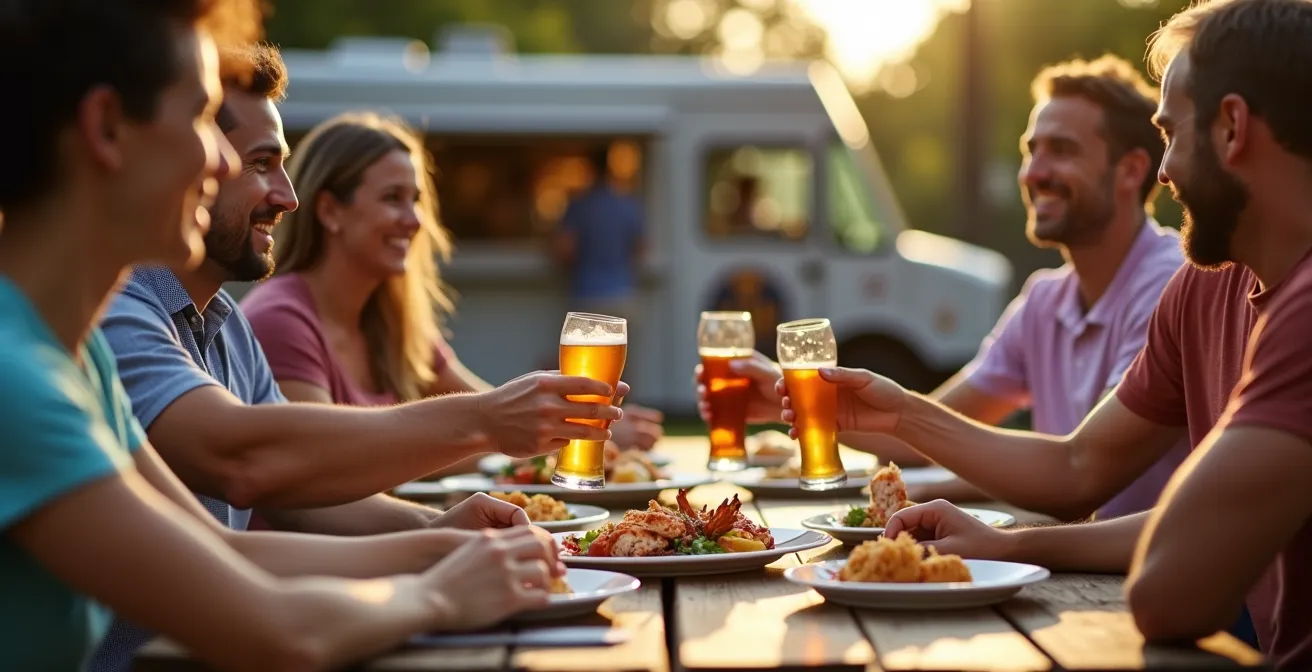
A prime example of this synergy is the long-standing relationship between Ad Mare Seafood and Kichesippi Beer Co. on Robertson Road. Ad Mare isn’t just parked there; they are an anchored culinary partner. Their menu of fresh fish tacos, lobster rolls, and fish & chips is a perfect match for Kichesippi’s portfolio of clean, crisp, and well-balanced beers. A crisp pilsner cuts through the richness of fried fish, while a more hop-forward ale can stand up to a flavourful seafood dish. This deliberate pairing enhances both the food and the beer, creating an experience greater than the sum of its parts.
When visiting a brewery, don’t just ask what’s on tap; ask about the food truck’s specialty and how it pairs. Check the truck’s social media (like Ad Mare’s Instagram) for daily specials before you go. The staff at both the brewery and the food truck are passionate about their craft and can often provide the best recommendations for a perfect pairing, turning a simple flight of beer into a memorable gastronomic event.
Beyond the Pale or Tooth and Nail: Which Taproom Atmosphere Suits You?
The physical environment of a taproom is a direct extension of a brewery’s brand and philosophy. This “Atmospheric Engineering” is a conscious choice that defines the customer experience. Are you looking for a bustling, high-energy space to socialize with a large group after work, or an intimate, cozy nook for a deep conversation over a complex ale? In Ottawa’s Hintonburg neighbourhood, two breweries located just minutes apart—Beyond the Pale and Tooth and Nail—offer a perfect case study in this deliberate divergence of atmosphere.
The choice between them depends entirely on the experience you seek. To help you decide, this table breaks down their key characteristics, as noted by local guides.
| Aspect | Beyond the Pale | Tooth and Nail |
|---|---|---|
| Location | 250 City Centre Ave (Hintonburg) | 3 Irving Ave (Hintonburg) |
| Atmosphere | Industrial-chic, bustling energy, spacious | Intimate pub-like, rock’n’roll vibe, cozy |
| Best For | Post-work social crews, large groups | Craft beer connoisseurs, intimate conversations |
| Signature Beer | Pink Fuzz citrus pale ale | Traditional styles, rotating small batches |
| Food Options | Full menu with sandwiches, tacos | Mediterranean pizzas, sandwiches |
Beyond the Pale Brewing Company offers a spacious, industrial-chic taproom that buzzes with energy. Its large size and open concept make it ideal for big groups and social gatherings. It’s a place to be seen, to celebrate, and to enjoy their lineup of bold, often hop-forward beers like the iconic Pink Fuzz. Conversely, Tooth and Nail Brewing Company cultivates a more intimate, pub-like feel. It’s cozier, with a clear rock’n’roll influence that creates a perfect backdrop for appreciating their nuanced, traditional-style beers. As one local review notes:
The staff here are obviously inspired by rock ‘n’ roll; Tooth and Nail’s Instagram page is spotted with the covers of albums that play over the brewery’s sound system
– Wanderlog Review
Neither atmosphere is inherently “better”—they simply serve different purposes. Understanding this allows you to tailor your visit to your mood and social context. It’s also worth noting that most Ottawa breweries are quite welcoming to families, but the vibe at a place like Tooth and Nail might be more conducive to a quiet adult conversation than the boisterous energy of a larger hall.
The Transport Mistake That Risks Your License After a Tour
For any brewing nerd, the tour’s focus is on the beer: the tasting notes, the process, the ABV, the IBUs. But the most critical number to remember has nothing to do with the beer itself. It’s 0.05. This is the blood alcohol concentration (BAC) that triggers Ontario’s “Warn Range” penalty. Many drivers mistakenly believe they are safe as long as they are under the 0.08 criminal limit, but this is a dangerous misconception. As Ontario’s ‘Warn Range’ regulations specify that a 0.05 BAC results in an immediate license suspension—a 3-day suspension for a first occurrence. This is the “Last Mile Problem” of brewery touring: ensuring a safe and legal journey home.
A standard tasting flight of four 5oz tasters can easily put a person over the 0.05 limit, depending on factors like body weight, food consumption, and the beer’s alcohol content. Simply “feeling okay to drive” is not a reliable metric. A responsible tour plan must include a transportation strategy before the first sip is taken. This requires more than just a vague intention; it demands a concrete plan.
Fortunately, Ottawa offers a range of options to mitigate this risk. From dedicated tour buses that handle all the driving to robust public transit and an extensive network of bike paths (though it’s crucial to remember that intoxication rules also apply to cyclists), planning ahead is straightforward. The following checklist provides a framework for creating a foolproof exit strategy.
Your Brewery Tour Safe-Exit Strategy
- Book a dedicated service: Use an all-inclusive provider like Brew Donkey Tours, which bundles transportation with curated tours across Ottawa.
- Leverage public transit: Map your route using OC Transpo, especially for brewery clusters like those in Hintonburg along Gladstone Avenue.
- Budget for a rideshare: Plan for an Uber/Lyft and budget approximately $15-25 for a trip within the central city area.
- Designate a driver: The most classic solution—ensure one person in your group commits to skipping the alcohol tasting portions of the tour.
- Consider active transport with caution: Utilize Ottawa’s bike paths, but be fully aware that operating a bicycle while impaired is illegal and unsafe.
In What Order Should You Drink Your 4 Tasters?
When a flight of four diverse beers arrives at your table, the temptation is to dive into the one that looks most appealing. However, the order in which you taste is critical to appreciating the subtle complexities of each brew. A common but flawed piece of advice is to simply go from “light to dark” in color. This myth fails to account for the single most impactful factor on your palate: flavor intensity, particularly bitterness (measured in IBUs) and alcohol content (ABV). As one Ottawa craft beer expert wisely puts it, you must:
Debunk the simple ‘light to dark’ rule – a light-coloured but intensely hoppy beer should be tasted after a darker, but smoother stout
– Ottawa Craft Beer Expert, Ottawa Tourism
The proper approach is a process of “Palate Calibration.” The goal is to start with the most delicate beers and progress to the most intense, preventing a powerful beer from overwhelming your taste buds and muting the flavors of the subsequent tasters. Hops, with their potent bitterness, are a primary culprit in palate fatigue. Therefore, a super-hoppy, light-colored IPA should always be tasted after a less bitter, darker beer like a brown ale or a smooth stout.
Here is the professional strategy for sequencing your flight:
- Start with Lighter Body & Lower Intensity: Begin with beers that are delicate on the palate, regardless of their color. This typically includes pilsners, lagers, wheat beers, or kolsches.
- Progress to Malt-Forward Beers: Move on to beers where the malt character is more pronounced but the hop bitterness is still restrained. This category includes amber ales, brown ales, and many stouts or porters.
- Introduce the Hops: Now is the time for hop-forward beers. This is where your Pale Ales and India Pale Sours (IPAs) come in. Their significant bitterness would have dulled your ability to taste the subtleties of the previous beers.
- Finish with the Strongest Flavors: Conclude your tasting with the most intensely flavored or highest alcohol beers. This includes double IPAs, imperial stouts, and any barrel-aged or uniquely spiced creations.
Between each taster, take a sip of water to cleanse your palate. And never hesitate to ask the brewery staff for their recommended order. They have an intimate knowledge of their products and can provide the ideal sequence to showcase their work.
Hop-On Hop-Off vs Guided Trolley: Which Covers More Ground?
While Ottawa has tourist-friendly trolleys, the real question for a beer nerd is how to efficiently cover the city’s sprawling brewery landscape. The choice isn’t between two tourist buses, but between a Do-It-Yourself (DIY) crawl using public transit and a specialized, guided tour like those offered by Brew Donkey. Each approach has distinct advantages in terms of cost, flexibility, and, most importantly, the kind of access you get.
A DIY tour using OC Transpo is the most budget-friendly option, with a single ride costing just a few dollars. This method works well for exploring a dense cluster of breweries, such as the ones in Hintonburg. However, it limits your reach to areas well-served by transit and restricts you to the public-facing taprooms. You get to taste the beer, but you won’t get the full behind-the-scenes experience. Reaching breweries in the outer regions like Kanata or Orleans becomes a significant time commitment.
In contrast, a guided tour is an all-inclusive package. While the upfront cost is higher, it includes transportation, curated stops, and—crucially—exclusive behind-the-scenes access. As highlighted by Ottawa Tourism, providers like Brew Donkey Tours offer friendly, laid-back brewery tours by bus that visit a wide variety of breweries, brewpubs, and craft beer bars. Their experts explain the brewing process en route, making the entire journey a learning experience. This method allows you to easily visit 3-4 breweries across different neighborhoods, including those that are difficult to reach by bus, without worrying about driving.
The following table breaks down the fundamental differences to help you decide which approach best suits your goals:
| Factor | DIY with OC Transpo | Brew Donkey Guided Tour |
|---|---|---|
| Cost per person | $3.75 per bus ride + beer costs | $130 per person all-inclusive |
| Breweries visited | 2-3 (limited by transit routes) | 3-4 guaranteed stops |
| Flexibility | Complete control over timing | Fixed schedule, set routes |
| Access | Public areas only | Behind-the-scenes brewery tours included |
| Best for | Hintonburg cluster exploration | Reaching Kanata/Orleans breweries |
How to Find a Quiet Coworking Spot in the Business District?
The line between work and life is increasingly blurred, and for the modern professional who also happens to be a beer nerd, the ideal “third place” might not be a coffee shop. An increasing number of breweries are becoming de facto coworking spots during off-peak hours. A spacious, well-lit brewery with good Wi-Fi can offer a more inspiring environment than a crowded café, with the added perk of a world-class beer waiting for you at 5 PM.
Finding a brewery that’s conducive to work requires a specific set of criteria. You need more than just a table; you need a productive atmosphere. Look for breweries with ample space, natural light, and accessible power outlets. Visiting on a weekday afternoon, typically between 2 and 5 PM, is the key to finding a quiet environment before the after-work rush begins. Many breweries also offer excellent non-alcoholic options like kombucha or craft sodas to keep you sharp during work hours.
In Ottawa, a location like Flora Hall Brewing fits this description perfectly. It offers a spacious, multi-level interior that can accommodate remote workers without feeling crowded. As one review from Best in Ottawa describes it, “Flora Hall’s interior is composed mostly of dark metal, tiles, and wood. This creates a chill ambience where people can gather with friends and relax.” This “chill ambience” during the day is ideal for focused work. To make the most of this trend, treat it like a proper workspace: buy drinks (even non-alcoholic ones) to support the business, be mindful of your volume, and pack up when the evening crowd starts to arrive.
Key Takeaways
- A brewery’s best beers are often taproom-only due to Ontario’s Tied House licensing, making on-site visits essential.
- Always taste beers from lowest to highest intensity (IBU/ABV), not by color, to avoid palate fatigue.
- Choose a taproom based on its “Atmospheric Engineering”—whether you want a bustling social hall or an intimate pub.
- Plan your transportation in advance, as Ontario’s 0.05 BAC “Warn Range” can lead to immediate license suspension.
Is the Haunted Walk of Ottawa Worth the Ticket Price for Locals?
For locals in Ottawa, finding repeatable, engaging activities that support the community is key. While tourist attractions like the Haunted Walk offer a fascinating glimpse into city history, their narrative is largely static. You do it once or twice, and you’ve heard the stories. A brewery tour, by contrast, offers a living, evolving experience that provides far greater long-term value for a local resident.
A brewery is not a static museum piece; it’s a dynamic production facility and community hub. The tap list changes weekly, new seasonal beers are released, different food trucks rotate in, and the community of regulars provides a consistently fresh social environment. A brewery tour can be a weekly ritual, whereas a historical walk is a one-time event. Furthermore, your money directly supports a local small business, contributing to a vibrant and innovative sector of the city’s economy. Some breweries even inhabit history themselves, like the Mill Street Brew Pub, located in a stunning grist mill building dating back to 1842. A tour there offers both a taste of living history and a taste of fresh, locally-made beer.
This table puts the value proposition for a local into sharp relief:
| Aspect | Haunted Walk | Brewery Tour |
|---|---|---|
| Experience Type | Static historical narrative | Living, evolving culture |
| Repeatability | Once or twice maximum | Weekly with changing tap lists |
| Local Value | Learn city history once | Support local businesses regularly |
| Seasonal Interest | Same stories year-round | Seasonal beers and food trucks |
| Social Factor | Tourist-focused groups | Local community gatherings |
Ultimately, investing your time and money in exploring Ottawa’s craft beer scene is an investment in your own community. It offers a endlessly repeatable, seasonally relevant, and socially engaging hobby that historical tours, for all their merits, simply cannot match. It’s about being part of a culture, not just observing it.
Now that you have the technical framework to decode Ottawa’s craft beer scene, the next step is to put this knowledge into practice. Use this guide to select the brewery whose philosophy, atmosphere, and operational footprint most intrigues you, and plan your visit. Your perfect behind-the-scenes tour awaits.